
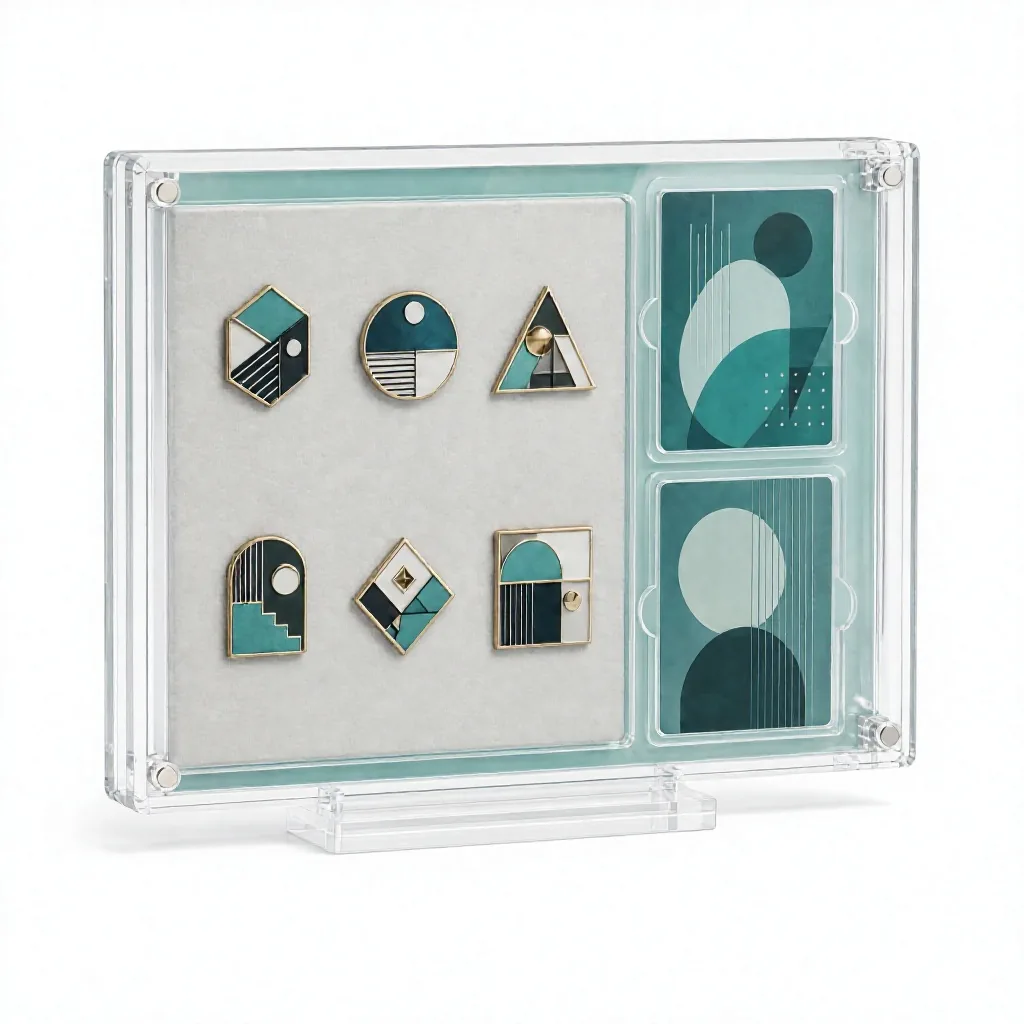
The brief behind MERCH-GRID DUO M is easy to say and fiddly to build: put enamel pins and photo cards in one clear frame, keep both reachable, and let the printed background change when the next series ships.
A frame like this is mostly air. What makes it work or fail is the 3 mm panel, the way the front and back panels line up, and whether the printed backdrop sits flat inside instead of buckling. Those three things are where most of the workshop time goes.
The panel does the heavy lifting
We cut MERCH-GRID DUO M from 3 mm cast acrylic (PMMA), not from thinner sheet stock. At 320 × 260 mm with a 292 × 232 mm visible window, 3 mm is the thickness that stays flat on a desk or a wall without needing a back brace. Thinner sheet flexes and lets the cards lean; thicker looks heavy and costs more than it needs to.
Edges get the same attention as faces. We laser-cut the panels and flame-polish the edges so they read as clear glass instead of a milky white line. A polished edge is the difference between a frame that disappears and one that draws attention to itself before the merch does.
Two card slots and one pin zone
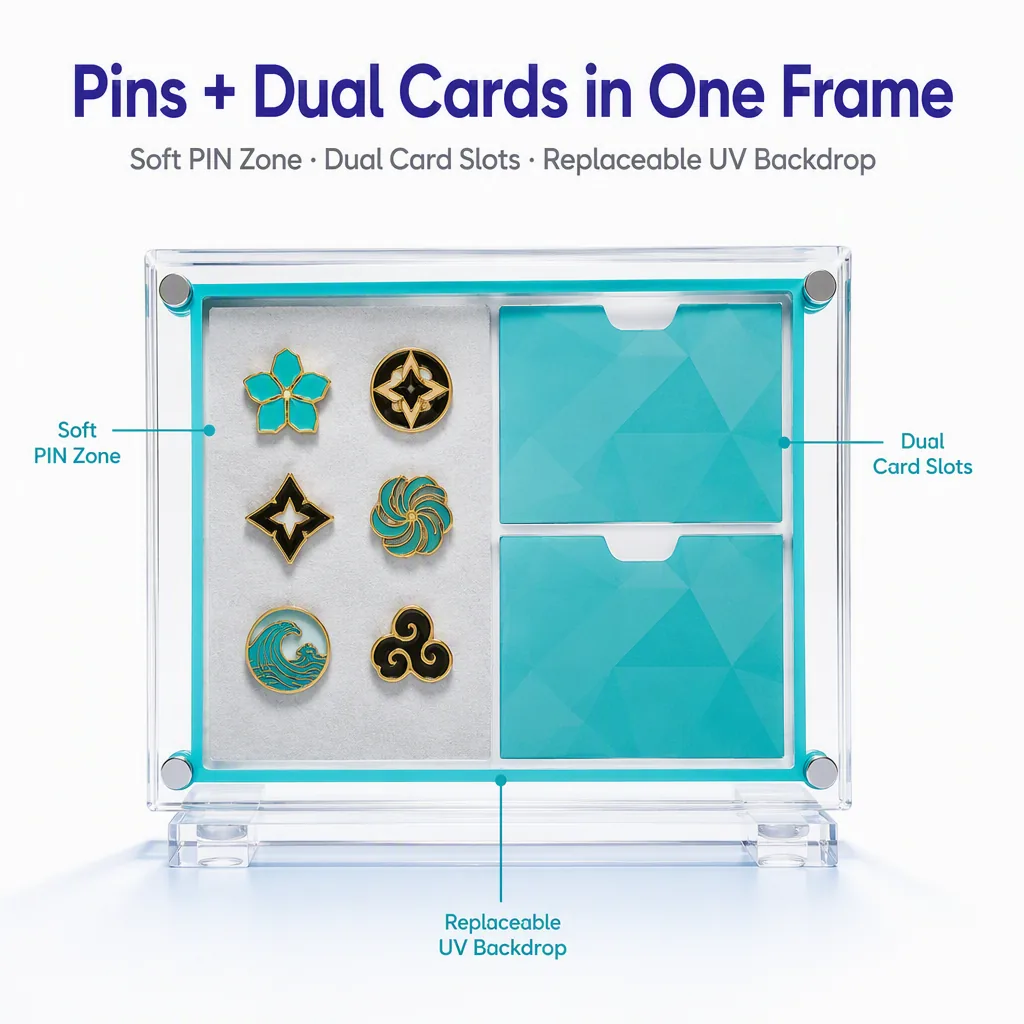
The layout is set by how the merch is handled, not by the frame. The left side is a soft pin zone — a felt-like surface that takes enamel pin posts without the punctured look you get from pushing pins straight into hard acrylic. The right side holds two card slots, each with a semicircular finger cutout at the top so a photo card or bromide slides out without tipping the frame.
The "DUO" is those two card slots. Pins and cards are different thicknesses and different weights, so they need different retention. One hard panel cannot do both jobs well, which is why we split them instead of forcing everything onto a single surface.
Keep the front and back panels in register
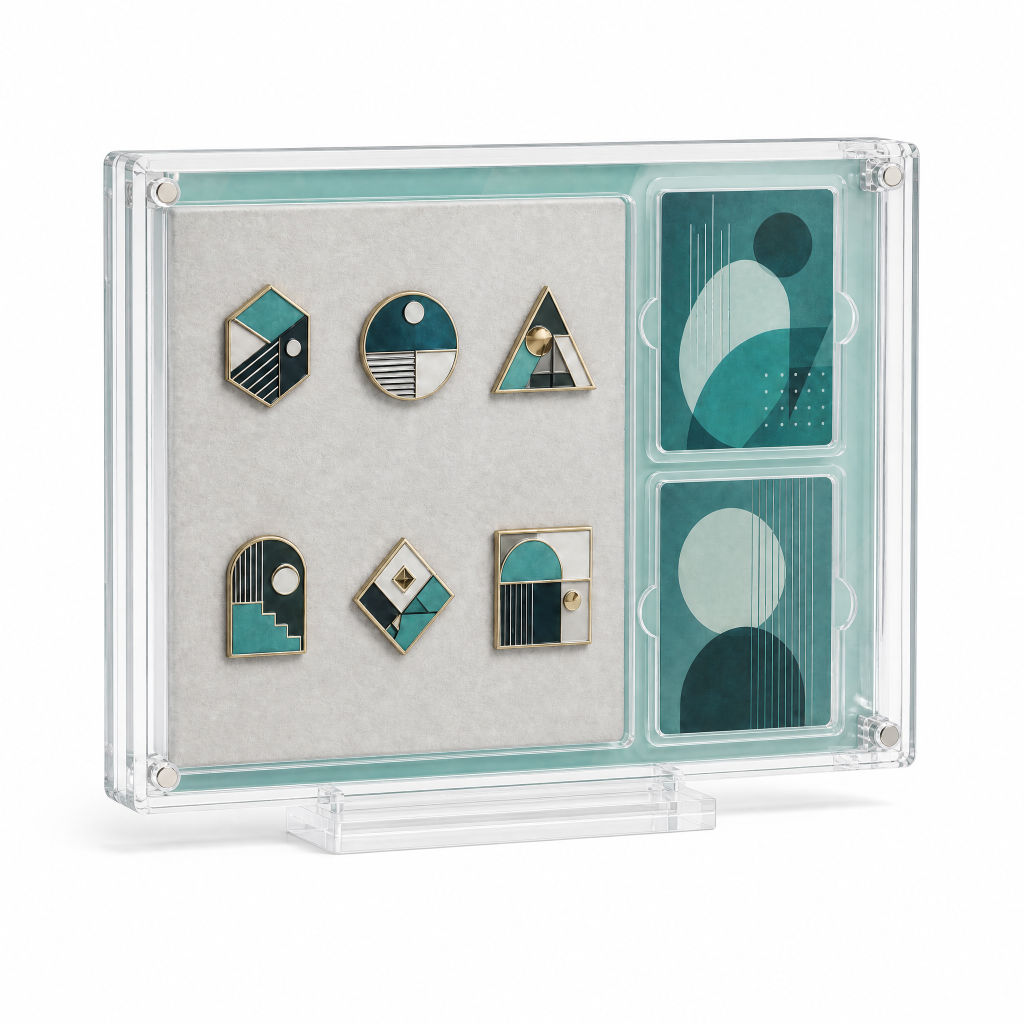
The frame is built as two clear panels — front and back — with the pin zone, cards and printed backdrop held between them. Four corner screws set the spacing; magnetic closures do the opening and closing. The magnets take the wear instead of the screw holes, which matters on a retail fixture that gets reset every time a new pin drops.
Because the panels are transparent, any misalignment shows up as a double line along the edge, so we check register before the panels are fixed. It is the kind of detail nobody notices when it is right and everybody sees when it is wrong.
A replaceable backdrop beats a re-buy
The printed backdrop is a UV-printed insert, not a sticker on the outside. UV ink cures onto the acrylic so there is no vinyl edge to lift or yellow, and the whole insert can be swapped when the next character line ships. The store keeps the frame and changes the scene, which costs less than replacing a one-piece display every season.
We keep the backdrop separate from the pin zone for the same reason: artwork changes, the engineering underneath does not. The MERCH-GRID system is built around that split so a refresh is a new insert set rather than a new project.
Desk or wall, same frame
MERCH-GRID DUO M ships with a foot for the desk and keyhole holes for the wall, so the same unit works on a counter or a slatwall. Orientation is a planning point, not an afterthought — a frame that reads well standing may need the pin zone and card slots flipped for a wall that people pass at eye level.
If you need a lit version, the interchangeable base from LIGHT-SLOT keeps the electrical layer separate from the acrylic. If the collection grows into a full enclosure, the same object-first principle runs through MODU-BOX.
What to send before we quote a custom frame
- Pin and card dimensions, and how many of each you need to show
- Backdrop artwork files, plus any areas that must stay unobstructed
- Desk or wall mounting, and the expected viewing height
- Frame size and the number of card slots
- Any branding on the frame or on the packaging
Even a rough list is enough to start a useful conversation. For the standard MERCH-GRID DUO M, sizes and options are on the MERCH-GRID page, and you can send a short brief through our project enquiry form.