
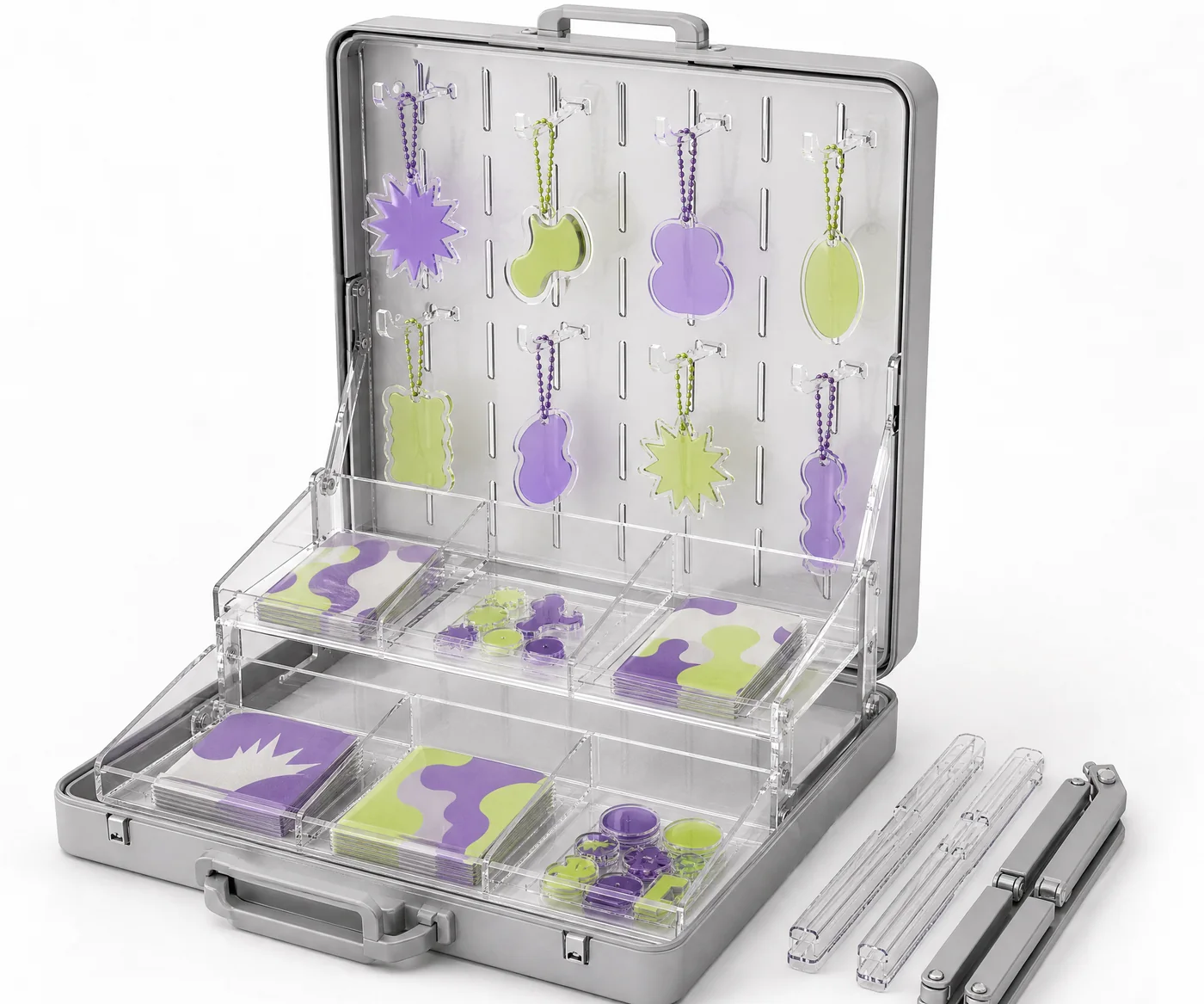
BoothCase follows the plug-together logic of STAGE-CASE, which is a display that assembles from flat panels without glue. Here the panels do not start life as panels. They start as a case, and the case has to close again at the end of the day with everything inside.
That last sentence is the whole design brief, and it is stricter than it sounds. Anything that only works one way, in or out, fails it.
The lid was the wall all along
The lid of a hard case is the largest flat panel a seller already owns. It becomes the vertical back wall, standing at roughly 100 degrees, with a slotted acrylic panel fixed to its inside face so tags and cards can hang at eye level.
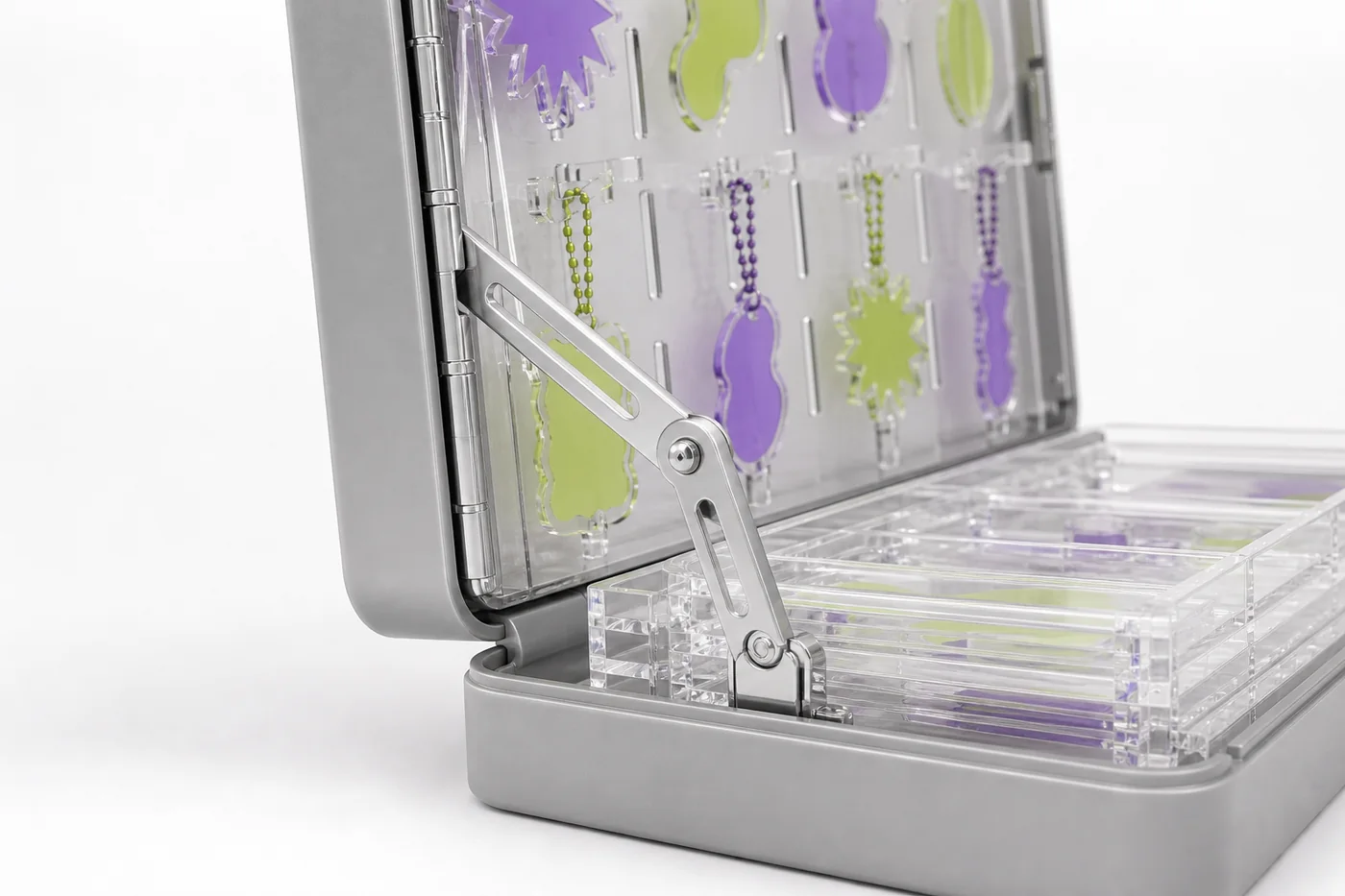
Angle matters more than it looks. At 90 degrees the panel is a wall and anything hung on it can swing forward into the stock on the table. At 100 degrees it leans back a little, so gravity keeps the goods against the panel and the customer sees a slight tilt toward them instead of a flat plane. The stay arm sets that angle and holds it. Remove the arm and the hinge has to carry the whole lid, which it is not drawn for.
The trays are the build, not the packing
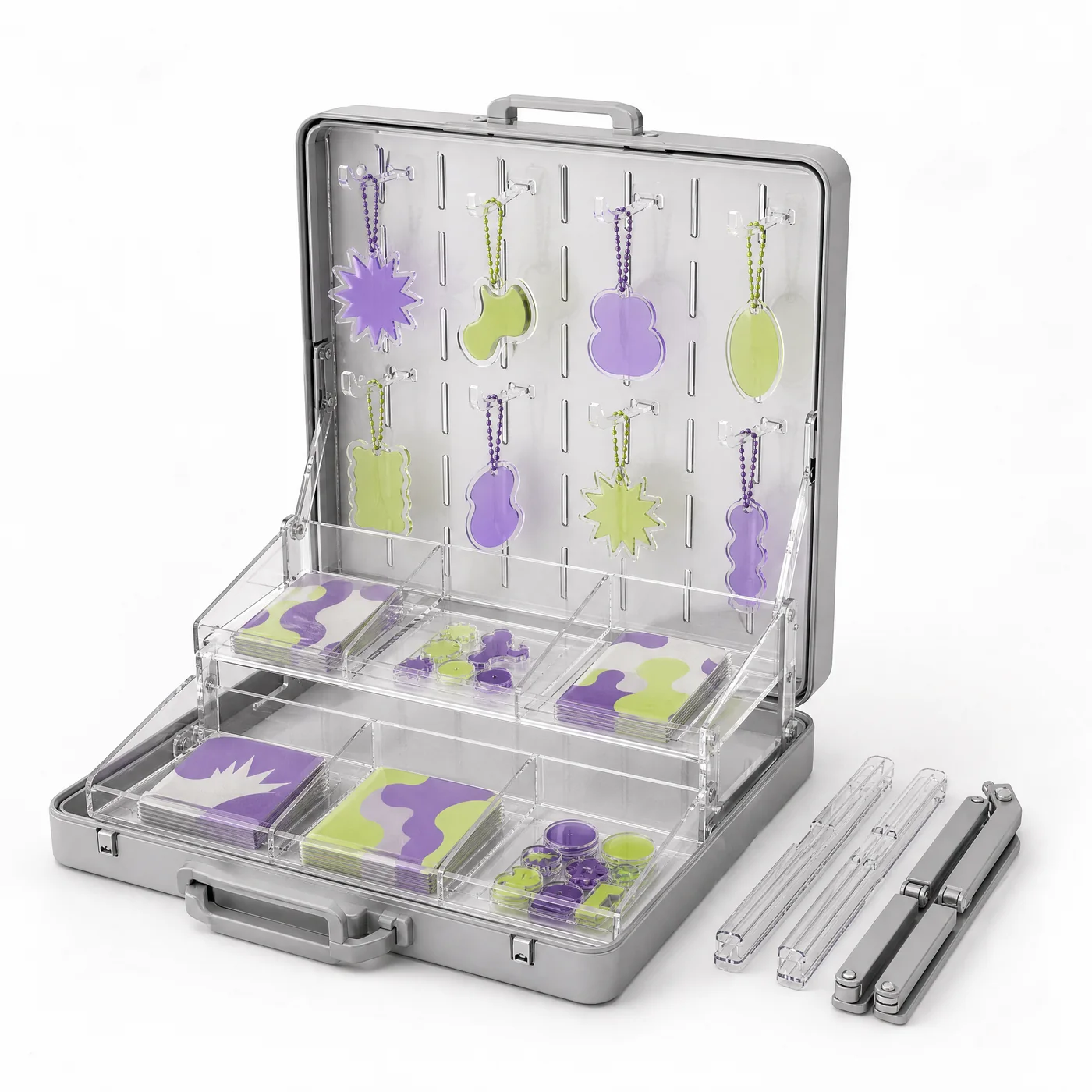
Inside, the clear acrylic trays stack into two levels. In transit they nest; at the table they lift out and sit on runners, so the same parts that protected the stock at 7am are holding it at 10am.
A stack of clear trays in a hard case rattles. Acrylic on acrylic, in a car, over a speed bump, sounds like something breaking even when nothing has. Thin felt pads on the stacking edges fix most of it and cost almost nothing. This is the kind of detail buyers ask us to remove to hit a price, and then ask us to put back after the first show.
The tray walls are the part that has to be right. Too low and cards slide over the edge when the case is tilted; too high and a customer cannot pick a card out without lifting it clear. The working height is set by the stock, which is why we ask for a sample card rather than a measurement.
450 × 330 × 90 mm is a car-boot measurement
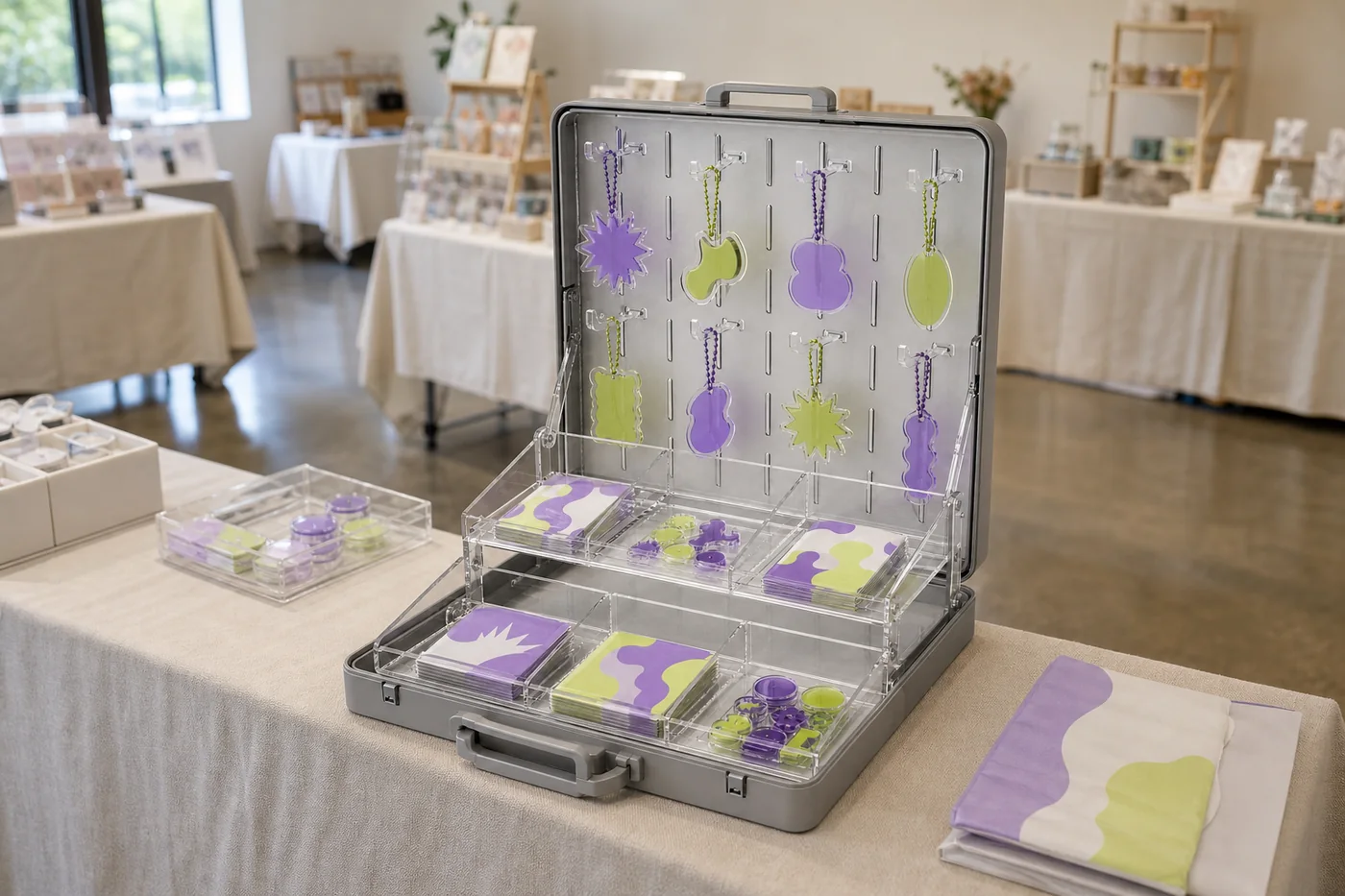
The case is roughly 450 × 330 × 90 mm in the current design, which is about the size of a large art folio. It goes under a table, in a footwell, or on a back seat without a strap across it. Depth is the number that matters: a deeper case carries more, and it also stops fitting under the table you have been given, which is usually the only storage a small fair offers.
The shell is a light grey hard case rather than acrylic, on purpose. Acrylic cases look better and crack at corners. A seller who has driven two hours and dropped the case on a kerb needs the shell to take the hit and the contents to be fine, so the acrylic inside is mounted to float clear of the walls.
Single person, no tools. Nothing more than that
We say the case goes up in one pair of hands with no tools, because that is what we build and test by hand. We do not put a setup time on it. A number like fifteen minutes is a claim about a specific person on a specific day, and the first time someone takes twenty-five minutes on a wet morning the number becomes a complaint.
The order is what makes it work: open the case flat, lock the stay arm, lift the trays onto their runners, then load the hook panel last, because a loaded panel changes the balance of the lid while it is still moving. Sellers who load the panel first end up fighting the stay arm.
Where it stops being the right product
Load figures are not published, for the tiers or for the hook panel. Adding a row of metal keychains to a loaded lid is exactly the case we have not measured, and we are not going to guess in writing. If a seller's stock is heavy and metal, this design is the wrong one until it has been tested with their actual mix.
Outdoors is the other limit. A lid at 100 degrees is a sail, and a folding stay arm is a hinge with a catch, not a tie-down. On a windy pavement the case needs something holding it that we do not ship.
And it is a one-table object. Two tables, two cases, two lids, and no way to join them into one back wall. A seller who needs a continuous wall is better served by the modular panels on the STAGE-CASE page.
What to send for a BoothCase quote
- What you sell and how it is best presented: hanging, in trays, or both
- The table size you are usually given, and whether the case has to fit under it
- Your largest single item, so the tray depth is drawn around it
- Whether the hook panel needs printed artwork or stays plain
- Whether the case carries your branding on the outside
A sample is one set; a small batch is 30–50 pieces and mass is 100+. Sampling runs 15 days, production 25 days, both from confirmed artwork and deposit, and every order is quoted rather than listed. The sample is where the stay arm, the tray depth and the rattle get settled. Panels that assemble without a case are on the STAGE-CASE page, and a brief goes through the enquiry form.