
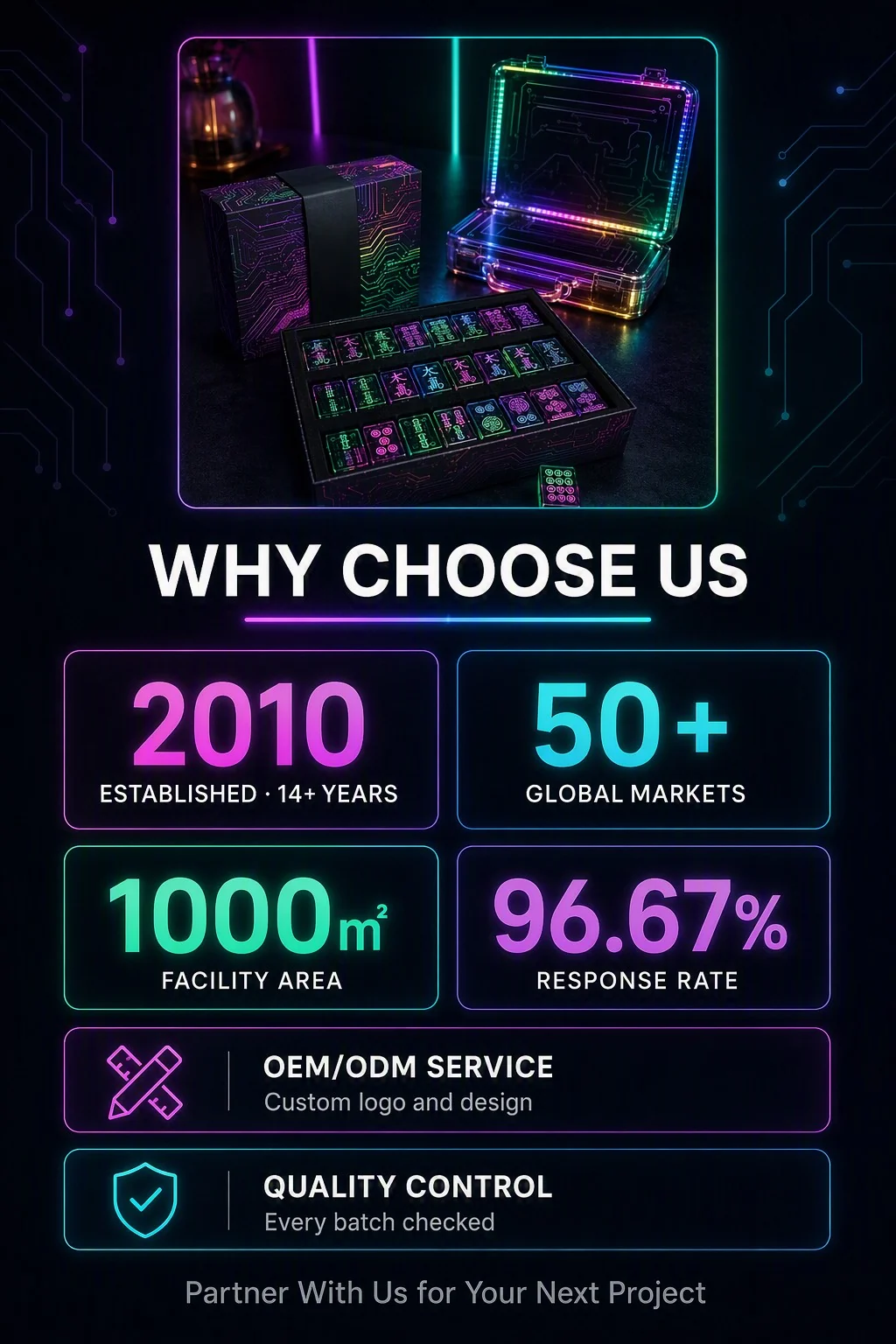
The light starts the occasion before the first tile is drawn. Open the presentation box and the circuit pattern runs in violet, cyan and green around the tray. Open the clear carrying case and an RGB strip frames the lid. The tiles carry the same colour language in their printed faces, so the set reads as one object rather than a standard game packed beside a lighting accessory.
That distinction matters in premium gifting. A high price does not create a high-end impression by itself. The box, the case and the playable object have to belong to the same design decision.
Three lighting layers, three different jobs
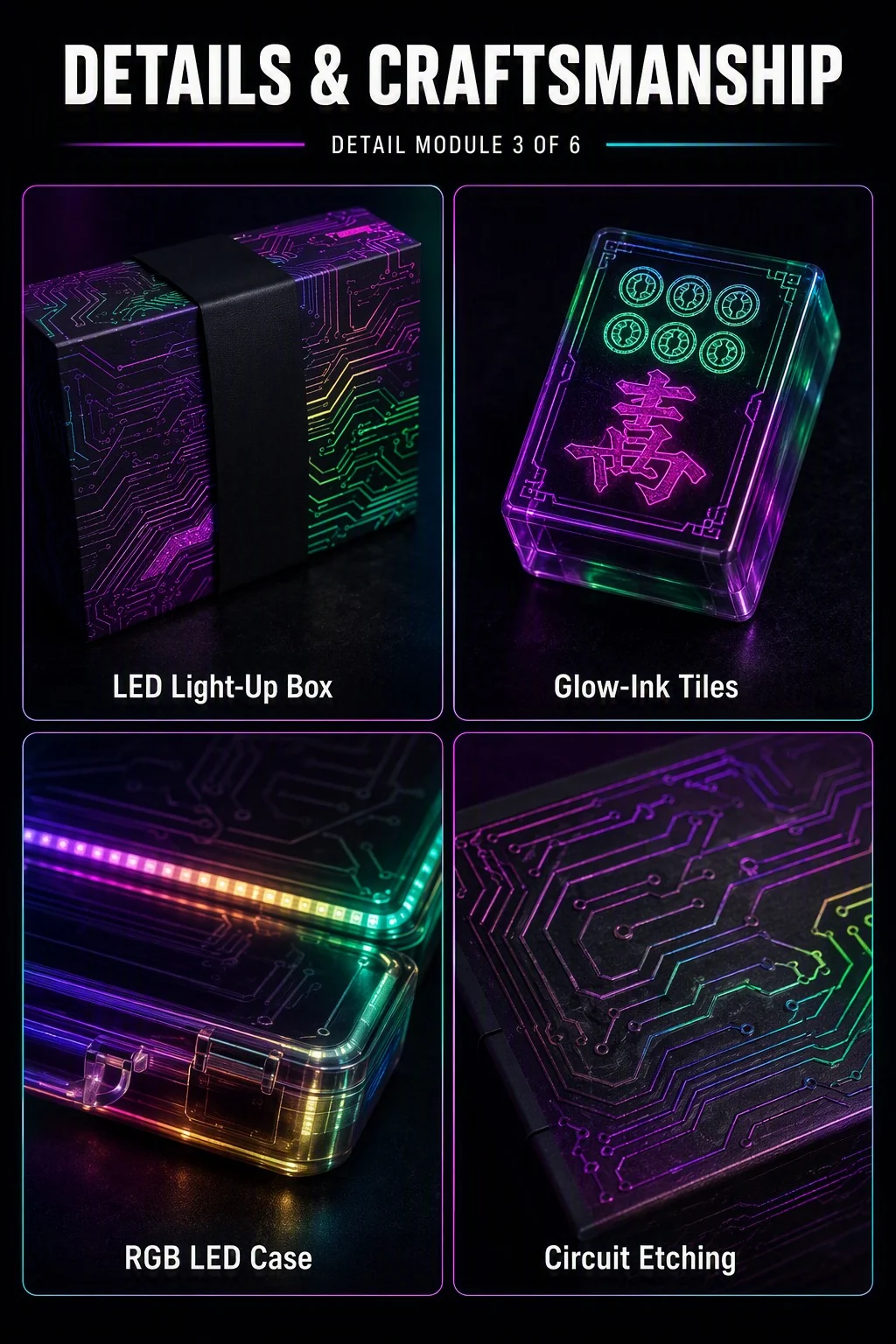
The listing identifies acrylic tiles with glow ink, an LED circuit-pattern gift box and an RGB LED carrying case. They should not be treated as one effect repeated three times.
The tile face needs legibility. Its characters and symbols still have to be read quickly across a table. The gift box creates the reveal. Its circuit pattern gives the closed package a recognisable surface before the ribbon or sleeve comes away. The carrying case changes the object after the game: placed on a shelf, it becomes a lit display case rather than storage that has to be hidden.
The circuit graphic is doing structural work
A generic luxury box normally relies on foil, velvet or a large logo. This design takes another route: the circuit trace is carried across the outer box, the tile tray and the transparent case. Repetition makes the set identifiable even when it is not illuminated.
It also gives customization somewhere useful to happen. A logo can be integrated into the circuit field or placed on the sleeve without covering the tile faces. The game remains readable; the brand still owns the presentation.
It still has to play like mahjong
A presentation gift fails when every part is too precious to touch. The visible set is arranged as a complete playing collection, and the product listing describes it as a mahjong game set, not a display sculpture. That practical identity is its strongest gift feature: the recipient has something to do with it after the photographs are taken.
The design review therefore has to begin with handling. Tile dimensions, face contrast, edge finish, print durability, tray fit and the way tiles are removed all matter more than adding another animation. A bright case cannot compensate for symbols that disappear under ambient light or an edge that catches the hand during play.
What makes it appropriate for a premium gift programme
A useful gift has a reason to stay. A distinctive gift has a reason to be remembered. This set covers both without asking the buyer to choose between them.
- First presentation: the illuminated package creates a clear reveal at a dinner, launch, anniversary or client handover.
- Identity: the circuit motif separates it from a conventional lacquered or imitation-leather mahjong box.
- Use after gifting: the recipient can play the game rather than store a commemorative object indefinitely.
- Brand space: the box and case offer visible areas for a logo, message or event graphic without crowding the tile symbols.
For corporate gifting, the last point should be handled with restraint. One mark on the sleeve and one inside the lid will usually read better than repeating a logo on every tile. The recipient should feel that the game was designed for them, not that they were handed an advertisement.
What the design visuals do not prove
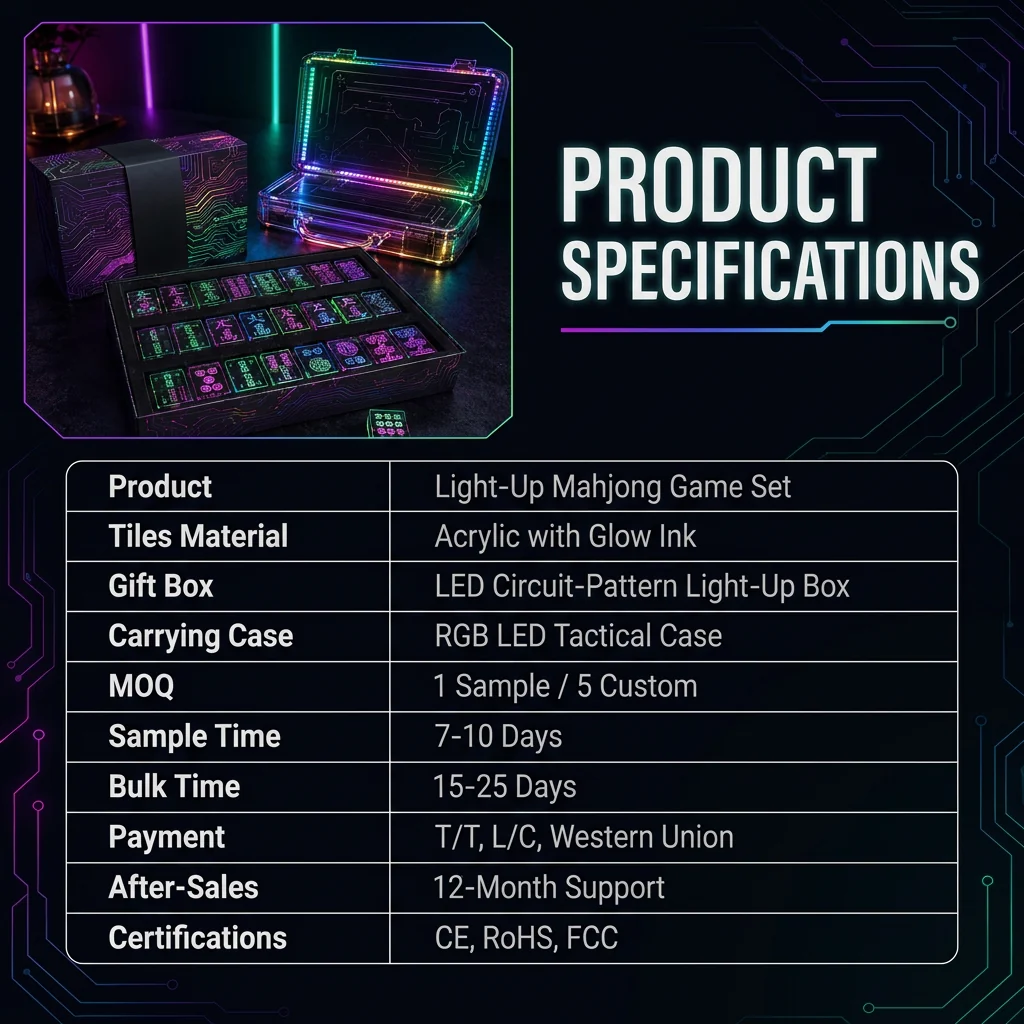
The source material shows the intended appearance, but it does not establish battery capacity, charging method, runtime, brightness controls, exact tile count, final dimensions or the drop resistance of the transparent case. Those are sample-stage questions. They should be written into an approval sheet and checked on a powered sample before a bulk gift programme is released.
The same applies to colour. RGB lighting changes how black acrylic and printed ink look in a dark room. A buyer approving colour from a screen should also review the set under ordinary room light, with the LEDs off. The object has to hold together in both states.
How ACRYLUME would brief the sample
Start with the occasion, recipient count and the way the gift will be handed over. A table presentation can use a wider reveal; a gift that travels needs the case and its internal restraint tested before the lighting sequence is refined. Then fix the playing requirements: regional tile format, marking set, replacement tiles and preferred feel in the hand.
From there, the illumination can be treated like a product system. Define which part lights first, whether the tile artwork relies on glow ink alone, where the RGB strip is visible, how the power is accessed and what the object looks like when it is switched off. The logic is close to our STAGE-CASE sound-and-light display system: electronics should support the object, not become the only reason the object works.
Send these details for a custom gift version
- Recipient type and gifting occasion
- Required mahjong format and destination market
- Logo, message and colour reference files
- Preferred lighting sequence and power arrangement
- Quantity, delivery city and handover date
- Whether one sample is needed for play, lighting and packaging approval
Send the brief through the project enquiry form. For a broader view of our collector-focused presentation systems, see the acrylic gifts collection and our note on integrating sound and light into an acrylic display case.