
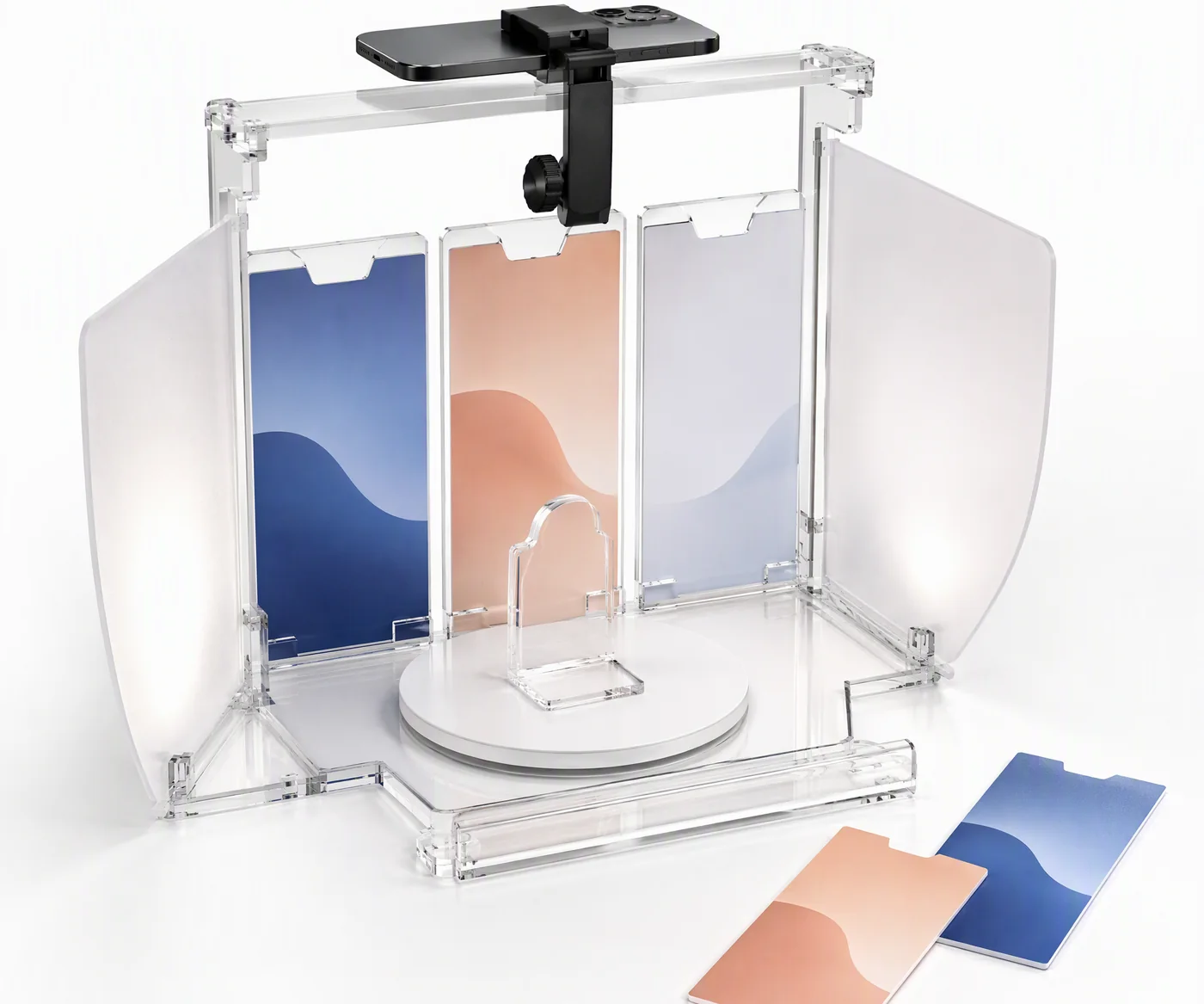
MerchDock takes the interchangeable-insert idea from LIGHT-SLOT and points it at a camera instead of a display. On LIGHT-SLOT the insert is a light source. Here the insert is a backdrop, and the thing that changes per product is a printed card rather than an LED module.
One frame does three jobs: it holds the phone still, it holds a background, and it turns. That is a desk setup rather than a studio, and the constraints follow from it.
The turntable is manual on purpose
There is no motor. That decision removes a cable, a speed control, a power supply and the failure that comes with all three, and it leaves the whole budget to the bearing surface under the disc. A turntable that turns slightly unevenly is worse than one you turn by hand, because the hand can pause where the light is right.
The cost is that a rotating shot needs a second pair of hands, or a phone that will shoot a slow pan while the operator turns the disc in even passes. For most sellers that is fine: they are photographing 12 items, not shooting a campaign.
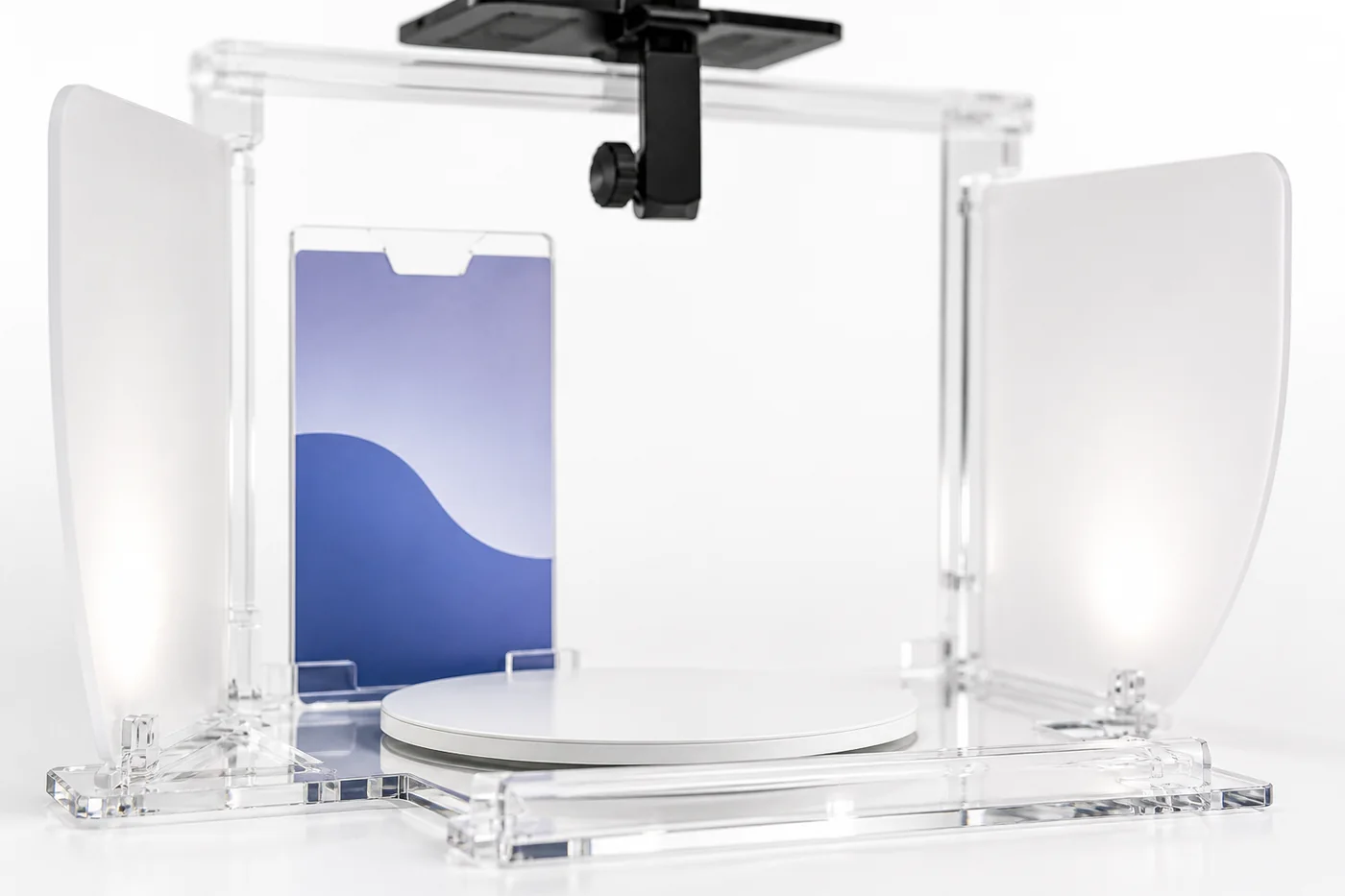
Backdrop cards are an insert system
Three slots at the back hold printed cards, and each card has a small locating tab so it can only go in one way up. The slot depth is what hides the bottom edge of the card behind the turntable disc, which matters more than it sounds: a card that stops short of the disc leaves a strip of desk in every photograph, and the fix in post is a crop that eats the top of the product.
The print choice is the part buyers get wrong. A gloss card reflects the room, and a phone camera plus a window will put a bright rectangle exactly behind the product. A matte card absorbs that light and reads as a soft gradient. If a buyer wants depth of field in the background rather than a flat wash, the card is printed with a gradient that imitates it, because a real background 30 cm behind the product at phone aperture is still sharp.
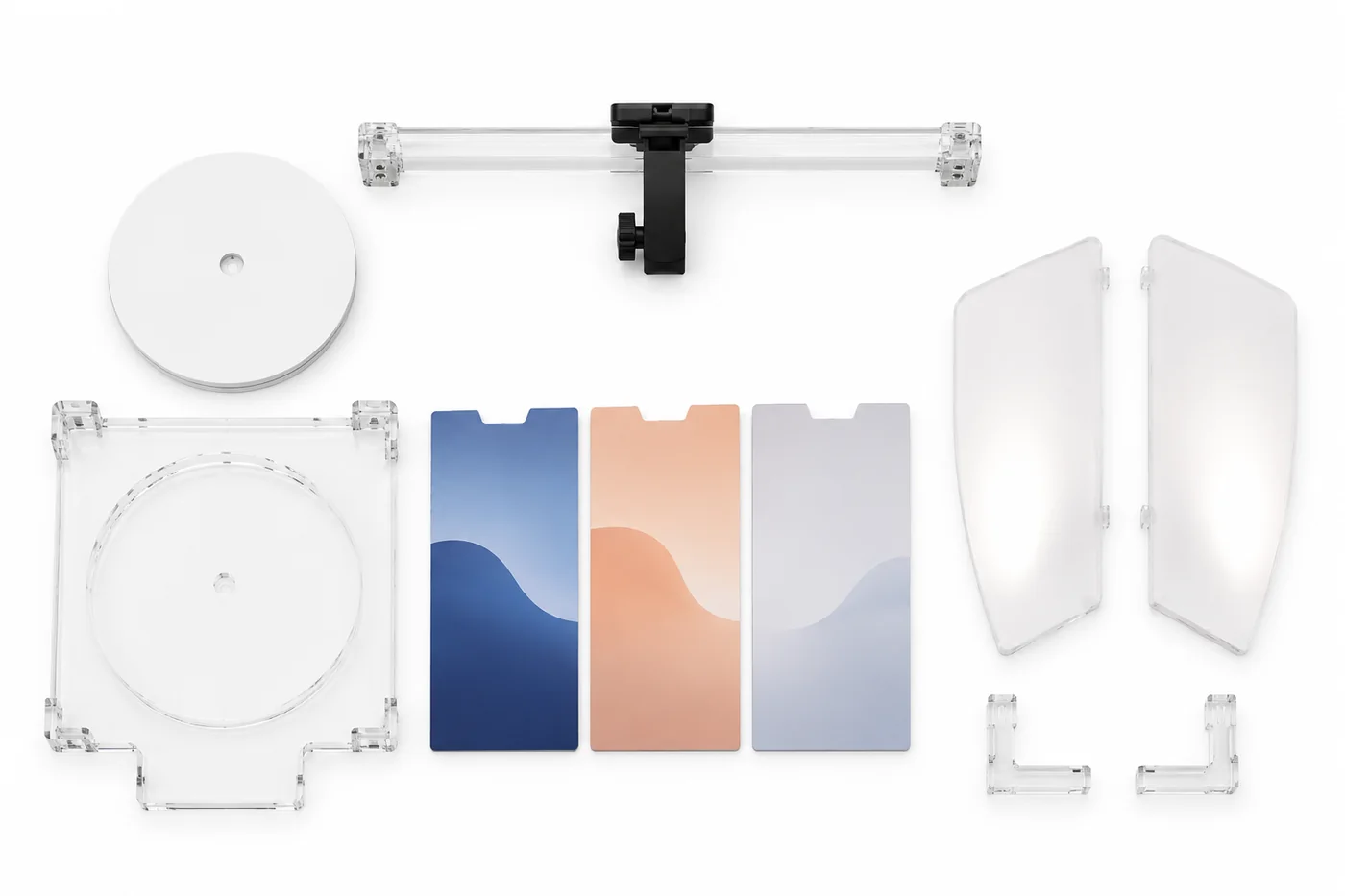
Two wings, no power
The side wings are frosted acrylic, angled forward. They do not emit anything. They catch light from the room and bounce a soft wash across the product, which fills the shadow side and takes the hard edge off a phone flash.
Passive is a real trade, not a compromise we are dressing up. In a room with a window or a decent ceiling light, the wings do useful work. In a dim room they do almost nothing, and no amount of angle fixes a light source that is not there. A powered version is a different product with a different price and a cable, and it is not this one.
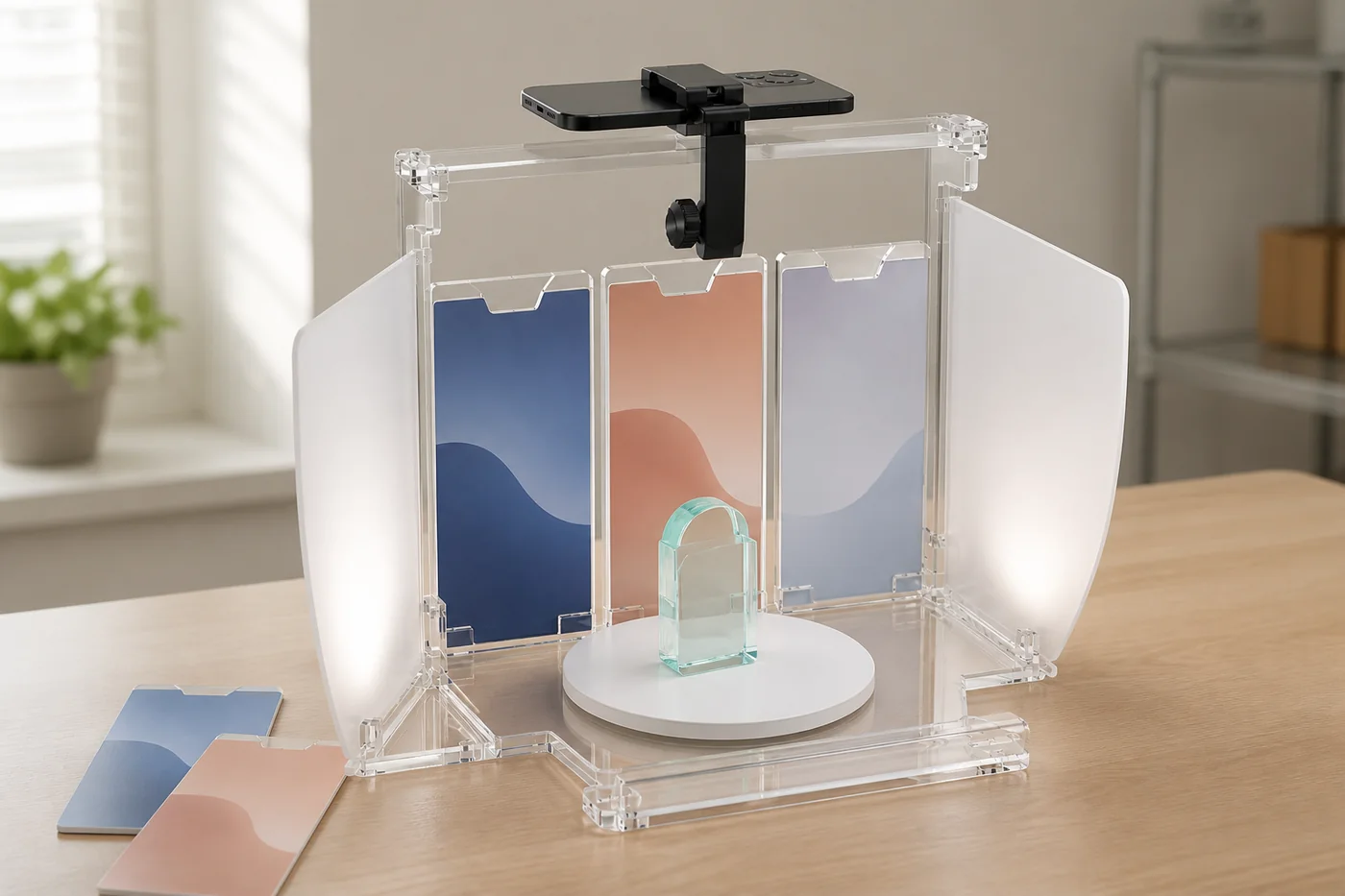
The phone bridge
The phone sits in a clamp on a horizontal rail across the top, adjustable in height and able to hold the phone in portrait or landscape. Every part of that is a cantilever, and a cantilever with a phone on the end of it is the weakest structural point in the whole frame. The rail is where the thickness goes: the current design runs 3–5 mm acrylic depending on span, and the top bar is at the top of that range for a reason.
We do not claim the clamp fits every phone. Modern handsets vary in thickness and in where the buttons sit, and a clamp that grips a bare slab is different from one that grips a cased phone. Buyers should tell us the device, and we will tell them whether the jaw opens far enough rather than let them find out.
Where it is the wrong tool
Large products are out. The frame is built for something you can hold in one hand, and a shoe box will not fit inside the wings. Dark rooms are out for the same reason the wings are passive. And if a seller needs consistent, repeatable lighting across a hundred SKUs, this is a desk accessory, not a lighting rig.
There is one more limit worth saying out loud. Clear acrylic in front of a lens behaves like a filter, and a frame this close to the product will show its own edges in a wide shot. Sellers either shoot tight or accept the frame as part of the picture. That is a choice about the photograph, and it should be made before the frame is bought.
What to send for a MerchDock quote
- The phone model and whether it is used in a case
- The largest object you need to photograph, with its footprint
- Whether the dock is for shooting only, or doubles as counter display
- How many backdrop designs you want in the first run
- Whether the frame should carry your branding on the base
Sample quantities start at one set, small batches run 30–50 and mass starts at 100. Fifteen days for a sample and 25 for production, counted from confirmed artwork and deposit, and pricing is quoted per project rather than published. The sample is where the clamp and the rail get checked against a real phone. The interchangeable base logic is on the LIGHT-SLOT page; send a brief through the enquiry form.