
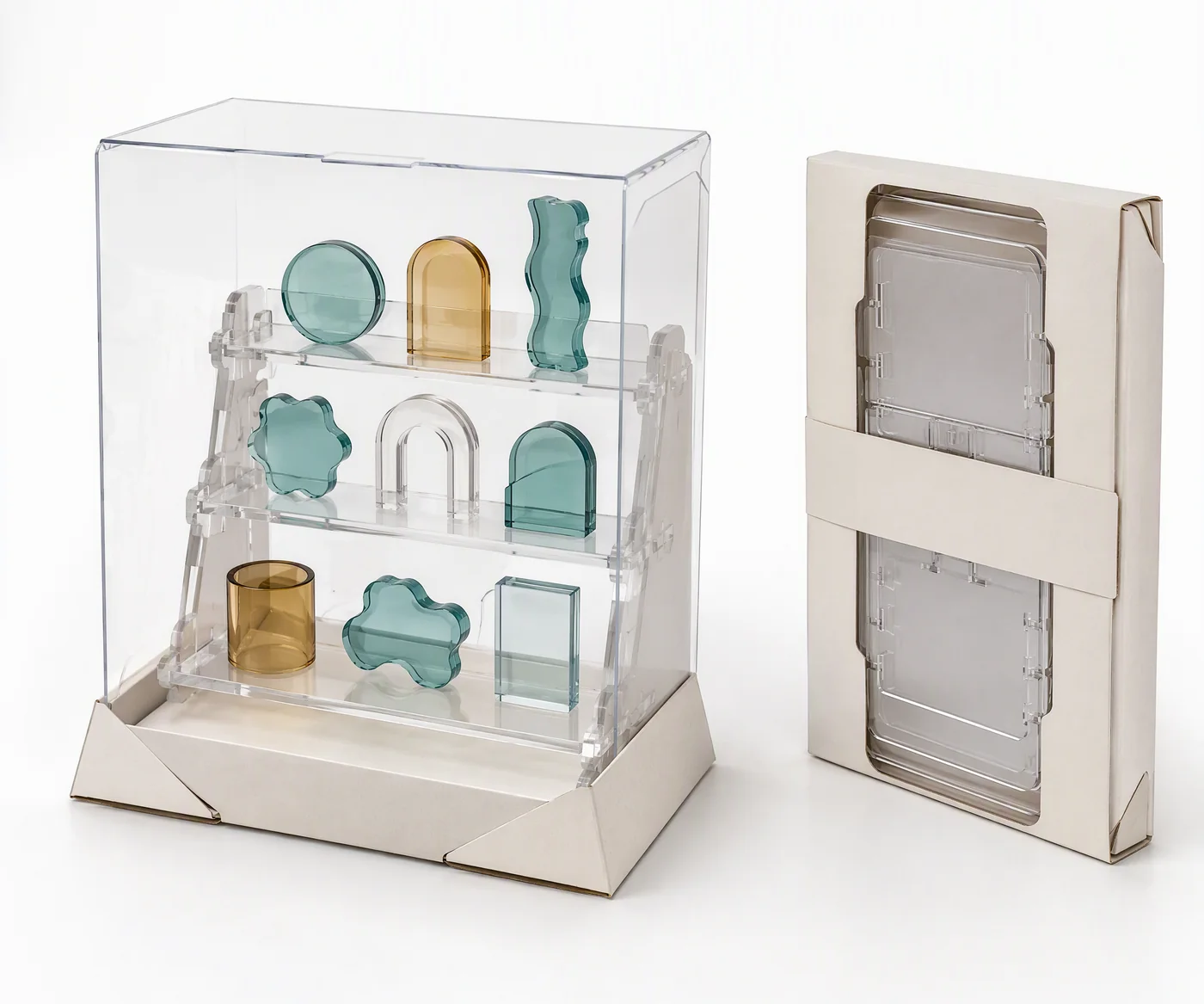
The idea came out of packaging work on CARD-VAULT, where a die-cut foam tray holds a card frame in transit. That tray already knew the product's shape. It was the obvious next step to ask why the part holding the product could not also be the part showing it.
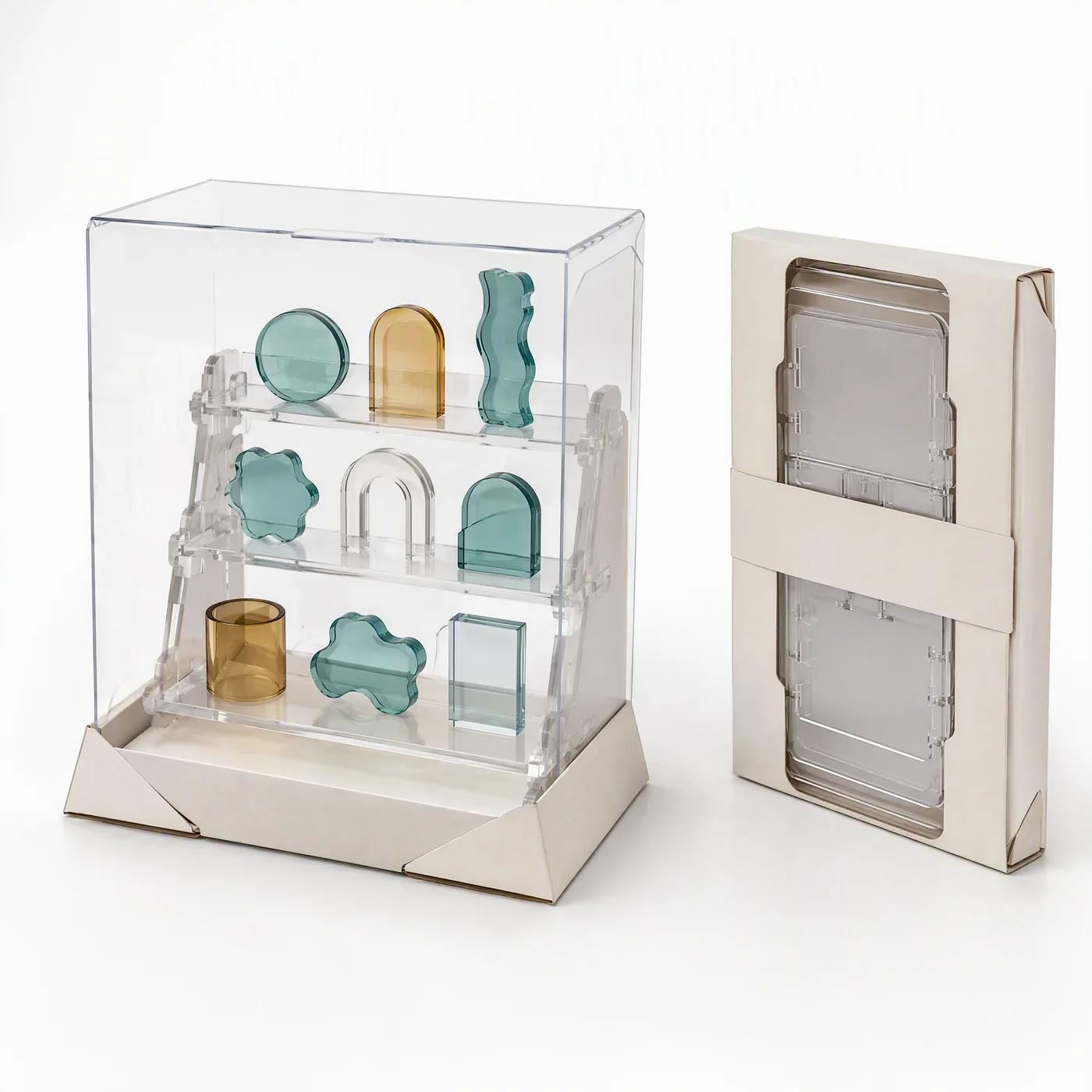
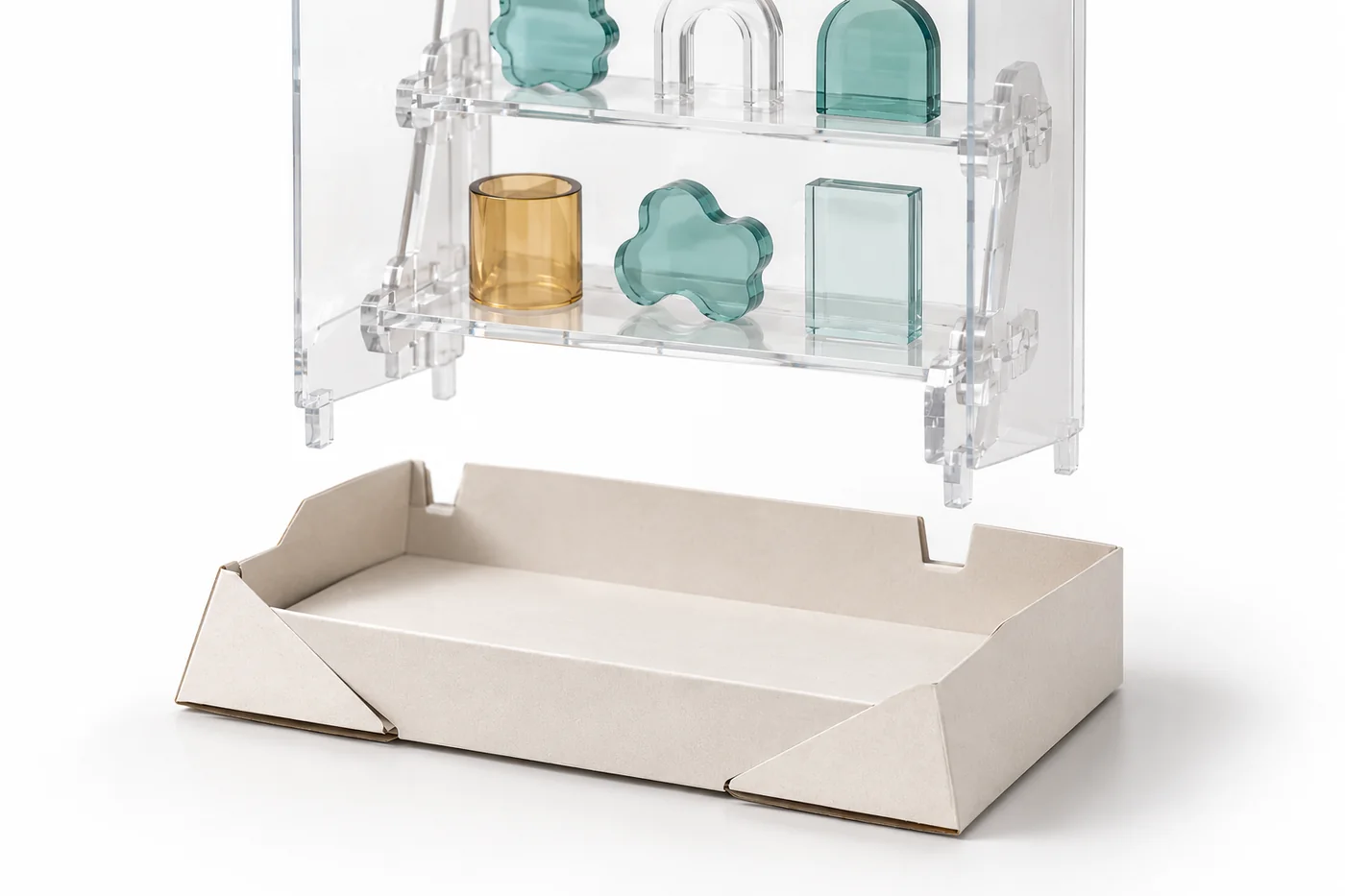
PACK-STAGE is the answer we were willing to ship: a die-cut board base, folded from the shipping carton, with a clear acrylic three-tier shelf insert that travels inside it and then locks on top.
The insert was always the display
In a normal gift box the acrylic insert is protection. It holds the product off the walls, stops it sliding, and gets discarded. Making it structural means the same sheet does three jobs: cradles the product in transit, becomes the tier set at retail, and stays visible while it does it.
The constraint that follows is real. A protective insert wants to be soft and forgiving. A shelf wants to be stiff and flat. One part cannot be both, so the split is: board handles the shock, acrylic handles the stiffness. Board is cheap, folds, and absorbs a corner impact by crushing a little. Acrylic does not crush, it cracks, which is why the acrylic in this design never touches the outside of the carton.
Board only folds one way
Cardboard has a grain, and the grain runs with the flutes. Fold a board across the flutes and the outer liner stretches while the inner liner compresses; do it on a score line and it works. Fold along the flutes instead and the sheet kinks, the flute collapses at the crease, and the corner loses most of its strength right where the unit is loaded.
So the die has one orientation, and that fixes the layout of the whole blank. It also decides where the locking tabs can sit, because a tab has to be on a panel that folds the strong way. We draw the fold sequence first and the graphics later. Buyers usually arrive with the graphics.
The tab is a friction lock, not glue, so the base can be folded back down and reused for the next delivery. That choice costs some rigidity: a friction tab creeps. Load the top tier heavily and leave the unit in a warm window for a month and the base opens by a degree or two. The alternative is a magnet pair at the two front corners, which holds the angle and lets the base still come apart. We quote both and let the buyer choose, because the friction version is cheaper and the magnet version is the one we would put in a shop window.
240 × 180 × 60 mm is a retail decision
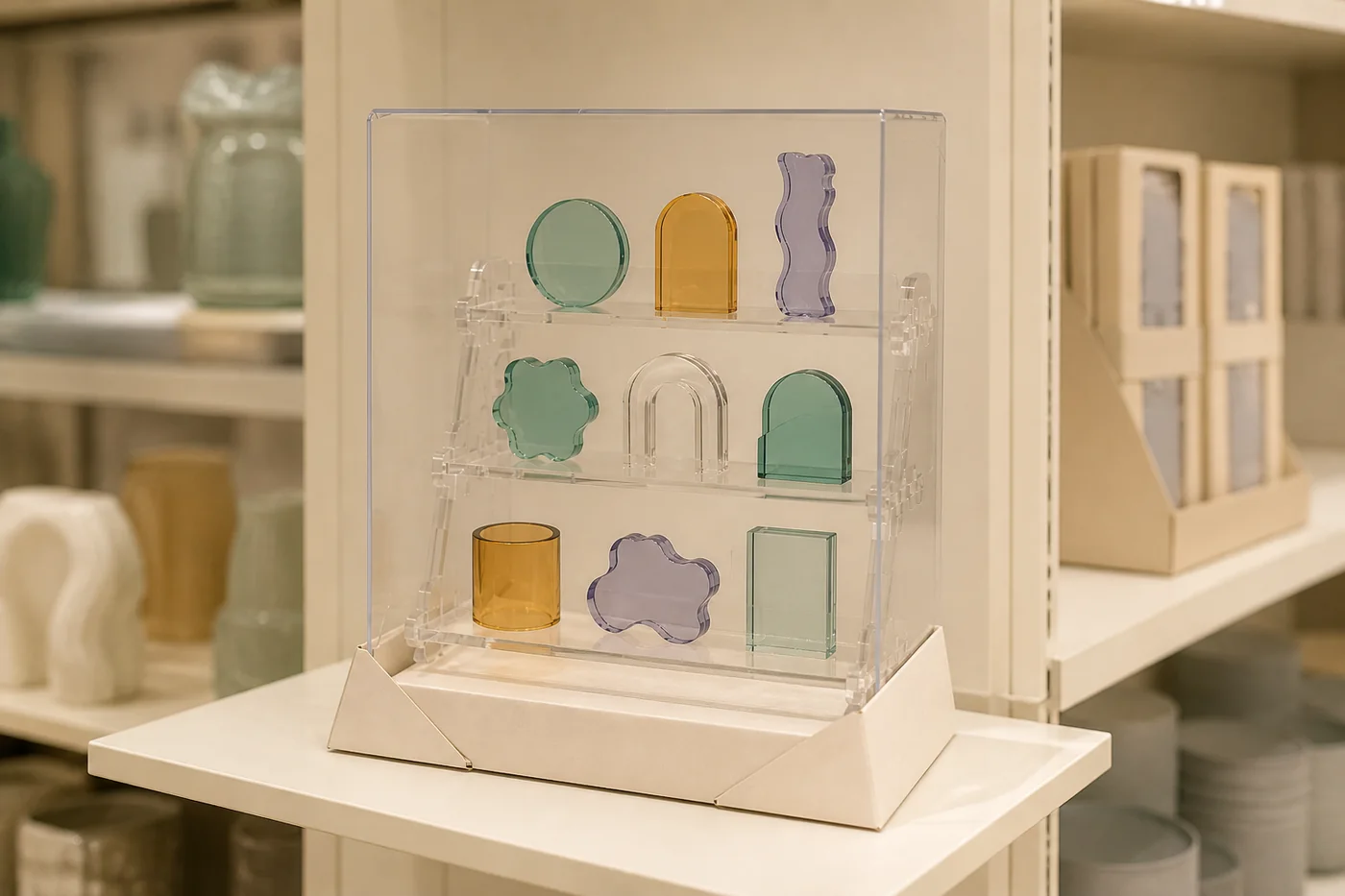
The flat pack is roughly 240 × 180 × 60 mm in the current design. That is not a shipping container size, it is a shelf size: it fits a standard retail shelf depth, stands up on its own edge, and leaves the front face free for artwork. A cube would protect better and waste shelf space. A flat envelope would ship cheaper and look like a mailer.
Flat also means the buyer assembles. That is the same trade as the RetailPod body, with a different consequence: here the assembly is one fold and one lock, and the customer sees the transition rather than just the result. For a gift or a launch, that moment is worth something. For a shop restocking forty units on a Monday morning, it is a cost, and the honest answer is that this product suits a premium line rather than a high-volume one.
What we will not put on a spec sheet
We do not publish a load rating for the tiers, and we do not claim the pack has passed a drop test. Neither has been measured on a production sample. What we can say is that a drop-tested configuration is available on request, which means we build the pack, send it to a test house, and quote from the result rather than from optimism.
Moisture is the other unglamorous limit. Board takes humidity and softens; in a humid climate a friction lock that was tight in the workshop can open on the shelf. Coated board helps, and a coated board changes the print, which is a conversation to have before artwork is approved rather than after.
Where this does not work
Heavy product is out. The tiers are 3 mm acrylic and the base is board; a stack of glass items will find the limit of both. Very long shelf life is out too, for the same moisture reason. And if the product is a collectible that a buyer keeps boxed, as card and figure collectors do, then a display that destroys the packaging is the wrong idea entirely.
What to send for a PACK-STAGE quote
- What goes inside: sizes, weights and how many pieces per box
- The retail shelf it has to fit, including depth
- How many tiers you want, and whether the stand is for one product or a set
- Friction lock or magnet lock
- Your artwork, and whether it also has to work as the box's outer print
The three MOQ bands are one set, 30–50 pieces and 100+. Sampling takes 15 days; production takes 25, both counted from confirmed artwork and deposit. Nothing carries a list price, so every order is quoted, and the sample is where the fold and the lock get tested by hand. Packaging thinking from the card range is on the CARD-VAULT page, and a brief can go through the enquiry form.