
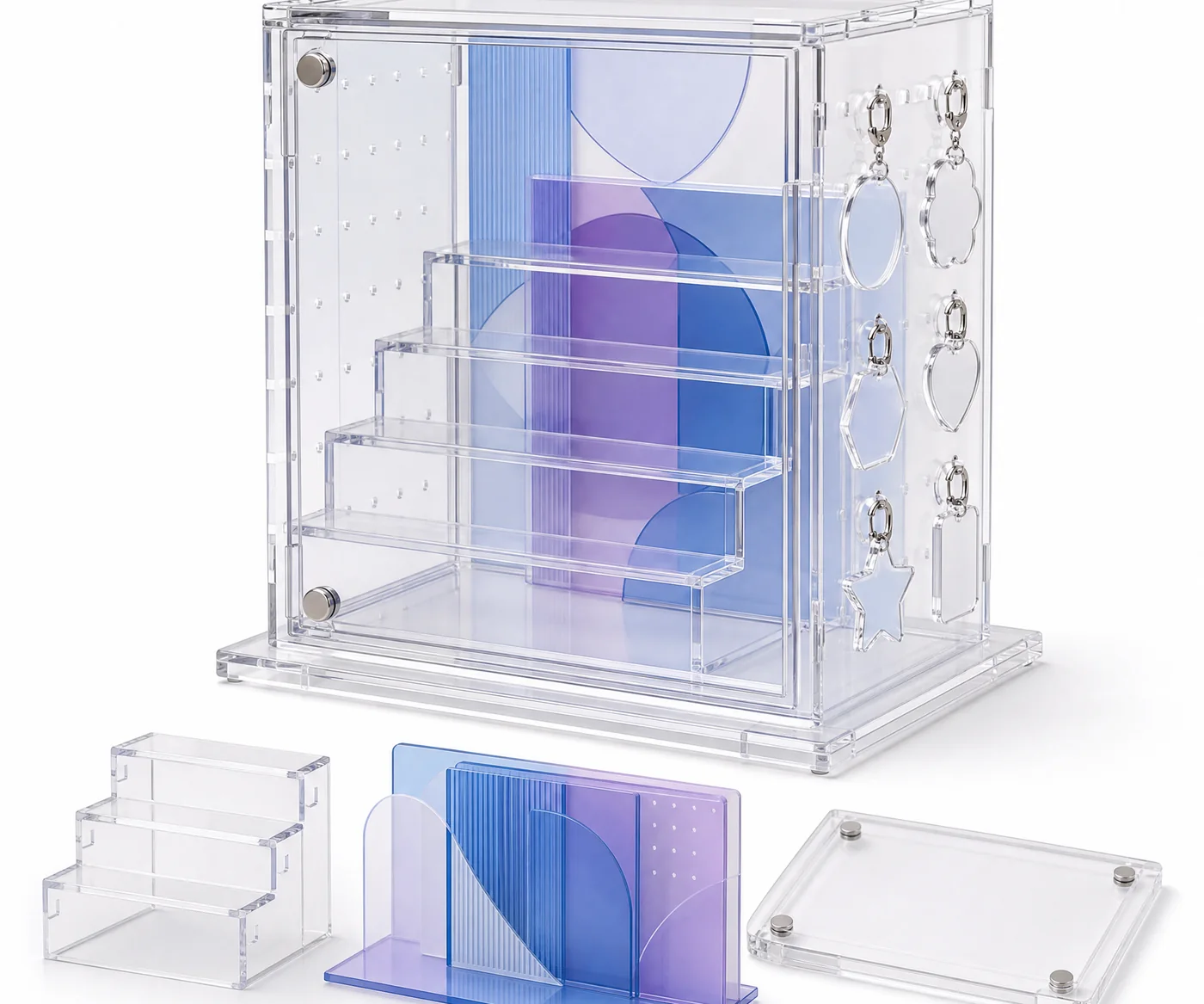
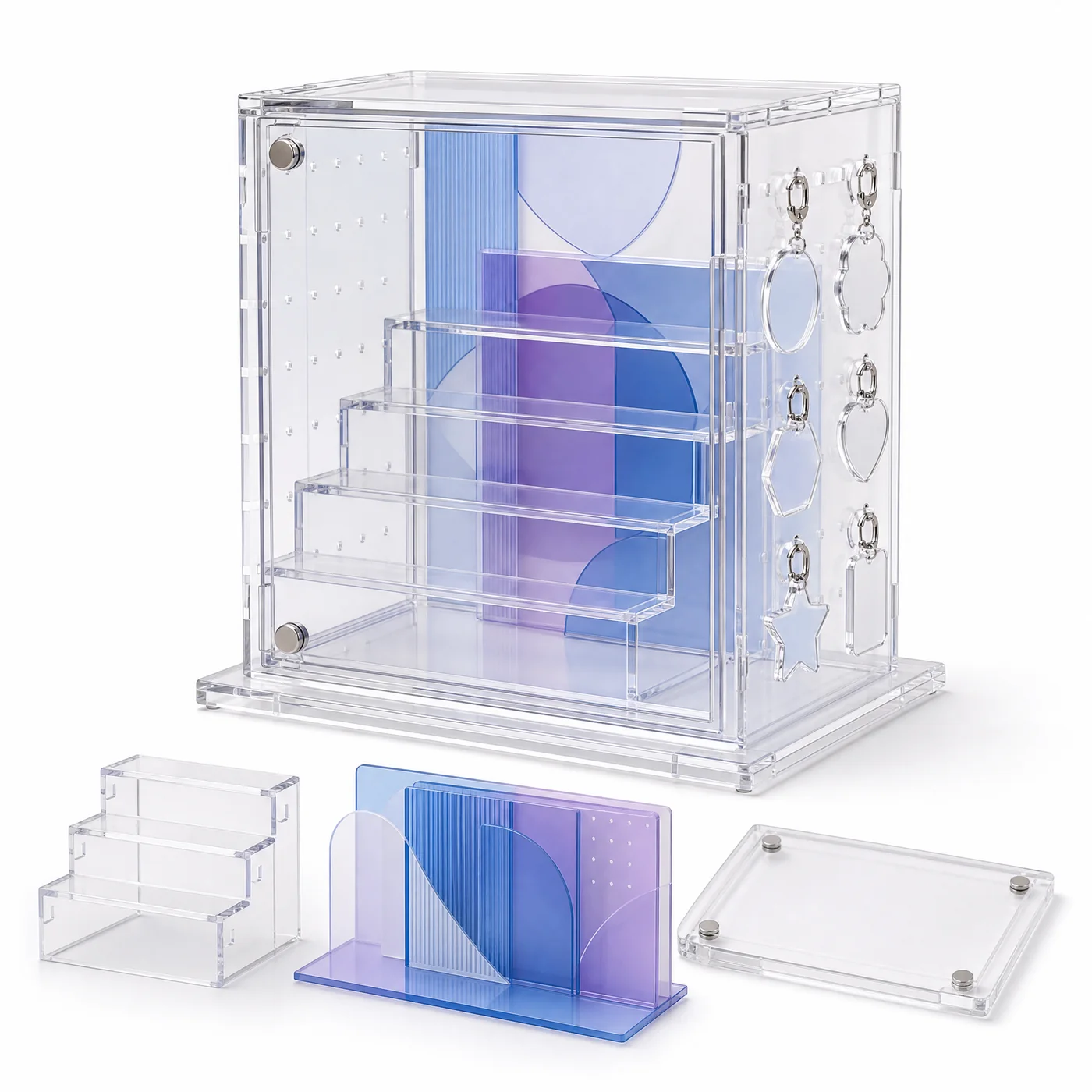
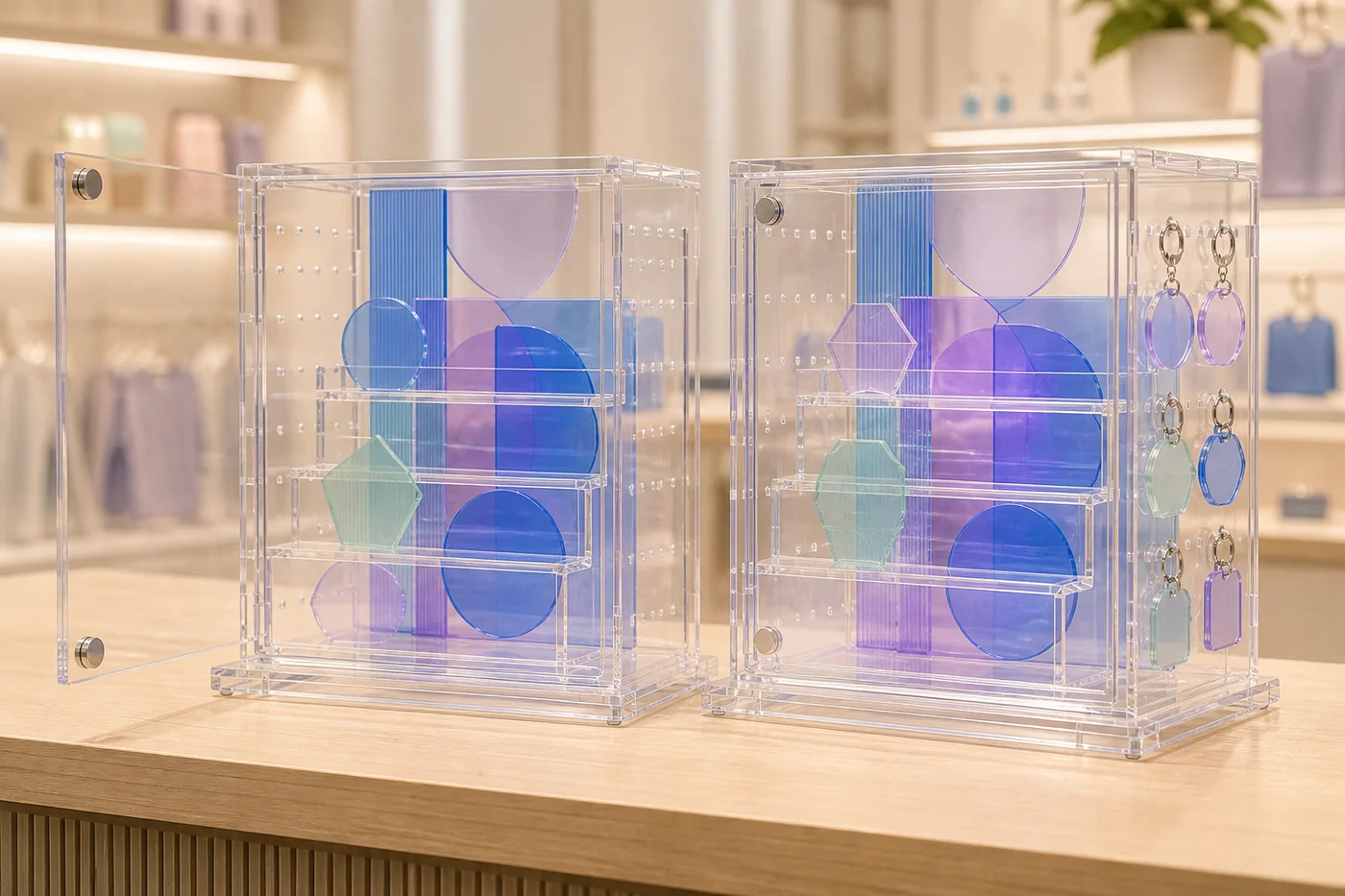
RetailPod is the retail branch of the MODU-BOX line. MODU-BOX is a cell you stack, closed on six sides, built for a collector's shelf. RetailPod keeps the same cell drawing logic and adds a front that opens, a selling step instead of a flat floor, and a side panel drilled to hang things from.
That last part is what makes it a shop object rather than a nicer box.
The door decides everything behind it
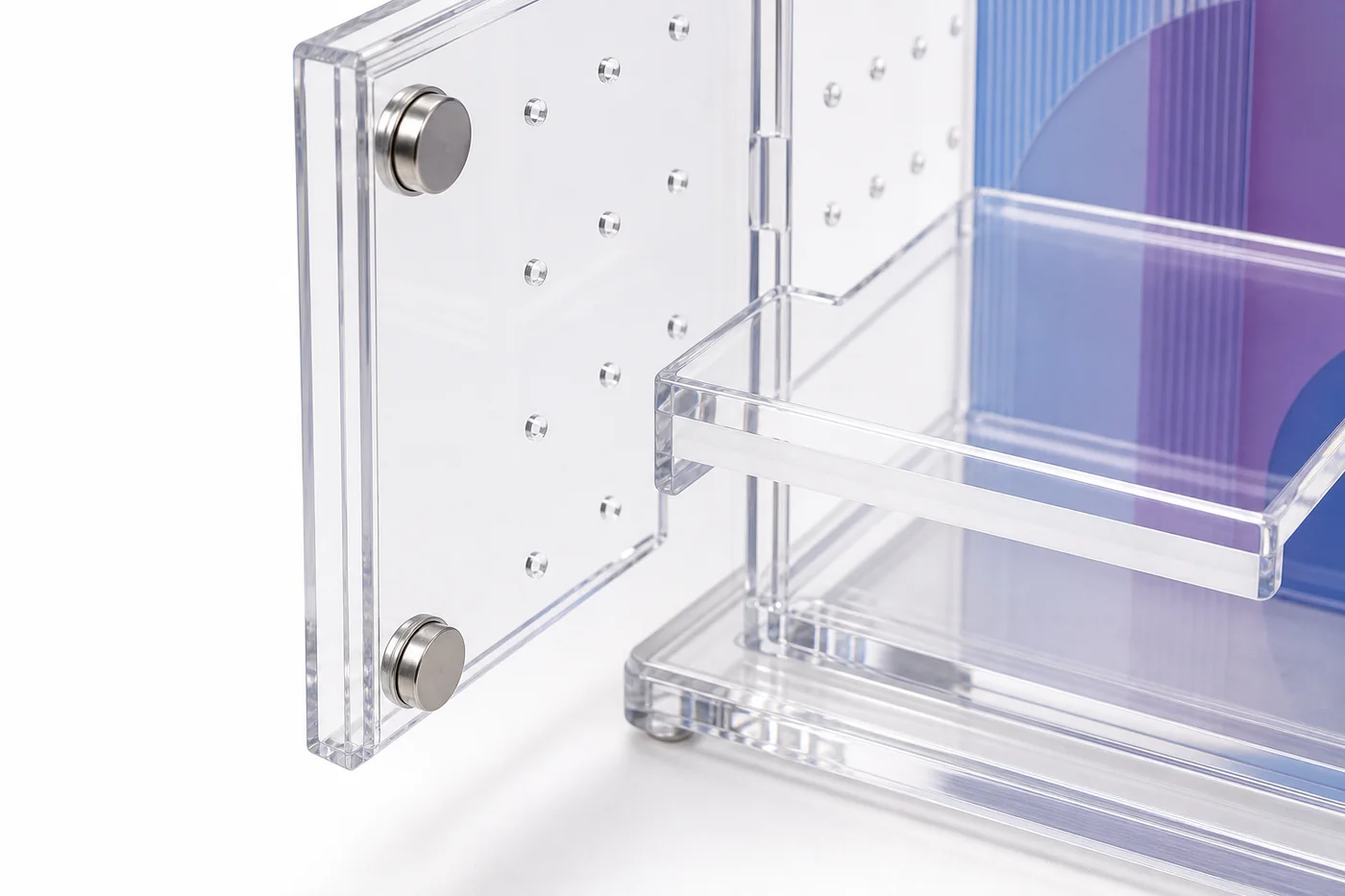
The front is held by magnets, not hinges with screws. Two of them, set into milled pockets in the door panel, meeting two steel pads in the body frame. Staff lift the panel off, restock, and drop it back. No tool, no thread to strip, no hinge to sag after a thousand openings.
Magnets are the easy part to get wrong. The pocket has to be milled, not drilled through, and milled to the magnet's own depth. Take out too much and the magnet sits below the surface with air behind it, so the door pulls in at the corners and stands proud in the middle. Take out too little and the magnet sits high, the door rocks on two points of contact, and the gap along the top edge changes width depending on which corner you press.
We check that gap with the door closed and the body empty, before any shelf goes in. A shelf can hide a bad door fit. It cannot fix one.
Stepped shelves, and the cost of making them removable
The shelves sit on a step, not on fixed brackets, so a shop can pull one out and drop it two positions lower when a new line arrives shorter than the last. That flexibility lives in one number: the slot width.
Cut it at the sheet thickness and the shelf will not go in after polishing. Cut it loose and the shelf tips the moment someone leans a hand on the front edge, which in a shop is roughly every ten minutes. What we aim for is a slot that takes the shelf with light pressure and holds it flat with stock on it. That number is set by the sample, not by the drawing.
The side panel carries a grid of small holes on the same pitch as the shelf slots. That is deliberate. Hooks, small clips and a shallow tray all read from the same grid, so an accessory made for one RetailPod still fits the next one a shop buys. Get the pitch wrong by half a millimetre across the panel and the error accumulates until nothing from the first order will seat in the second.
Only the back panel changes per season
The printed back panel is a 3 mm sheet that slides down two channels, and it is the cheapest part of the whole build to redo. A shop changing theme buys a back panel, not a cabinet. That is also what makes the product work for an IP line: the structure stays neutral, and the licensed artwork lives on one part that can be withdrawn without scrapping the tooling.
We print it on the inside face. Printed on the outside, a back panel gets wiped, dragged past zips and stacked against other units, and the ink shows it within a month. Printed inside, the acrylic takes the wear and the print sits behind it, which is also why the colour reads deeper than a sticker ever does.
Flat pack is not a shipping trick, it is a joint decision
The body ships as flat panels rather than a bonded box, for the obvious reason that a 300 × 220 × 360 mm shell is mostly air. The less obvious consequence is that every corner becomes a joint the buyer has to make, and every joint is a line.
Tab and slot, then solvent cement, gives the strongest result: the cement softens both faces and the joint fuses into one piece of material rather than sitting on top of it. It also leaves a faint witness line along the seam that nothing removes. On a clear case you see it. That is the trade. A mechanical interlock keeps the seam cleaner and survives being taken apart, but it never gets as stiff, and on a body this size you can feel the difference when you open the door.
Cutting is the other half. Every panel is nested on one sheet, and the laser takes its own kerf out of each cut, so a slot drawn at nominal width arrives narrower than drawn. Nesting tight saves material and puts more heat into the sheet; nesting loose costs sheet and keeps edges cleaner. We nest to the part that matters most and accept a little waste elsewhere.
What this box does not do
It is a display and selling unit, not a sealed case. The door closes on magnets, not on a gasket. Dust will find the gap along the bottom edge, and if a shop needs a sealed enclosure, the answer is a MODU-BOX-style closed cell or a sliding-door CARD-VAULT frame, not this.
UV film is quoted per project rather than assumed, because the film changes the colour of everything behind it and some buyers would rather have the clarity. Load figures are not published. The shelves are sized for retail stock, and we would rather test a loaded unit at your sample stage than put a number in a brochure that nobody has verified.
The sizes in this piece are the current design targets: a body in 3–5 mm acrylic at roughly 300 × 220 × 360 mm. Thickness follows the span and the stock weight, and both get settled when a sample is on the bench.
What we need before quoting a RetailPod run
- The stock you sell: heights, footprint, and the heaviest item that will stand on a shelf
- Whether the unit is for sale from or display only, since that changes the door and the step depth
- Back panel artwork as AI or PDF, with bleed, or a note that you want a plain translucent panel
- Counter or floor, and the height customers will be looking from
- Whether the side panel needs hooks, a tray, or both
- Your branding position, if any, and whether it goes on the body or the packaging
MOQ is one set for a sample, 30–50 pieces for a small batch, 100+ for mass. Sampling takes 15 days and production 25 days, both counted from confirmed artwork and deposit. Prices are quoted per project, and the sample comes first because the shelf slot and the magnet pocket are the two dimensions nobody should sign off on paper. The rest of the system is on the MODU-BOX page, and you can send a brief through the project enquiry form.