
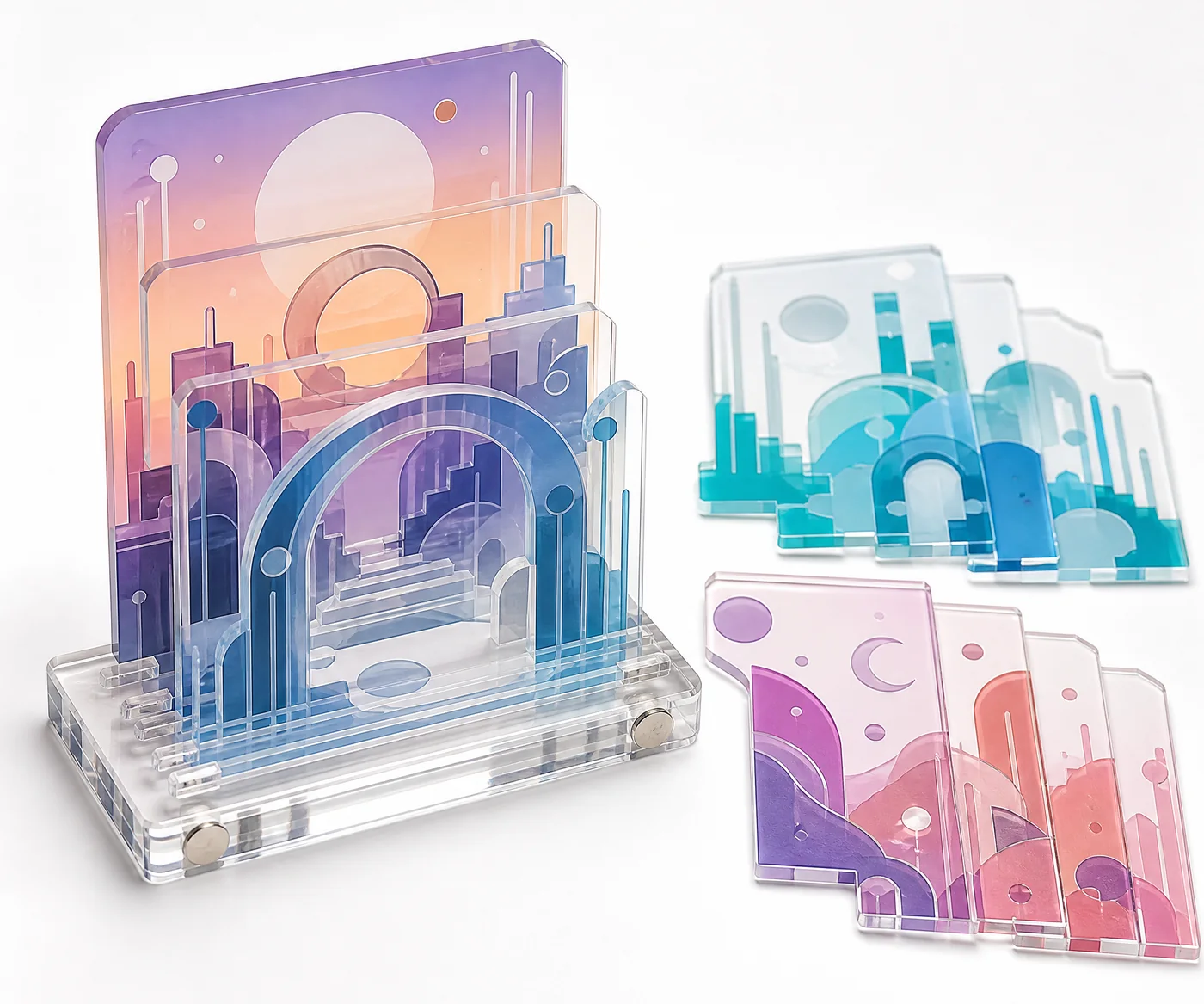
SCENE-SWAP belongs to the same technical route as SCENE-LAYER: separate panels, cut to their own outlines, held at fixed distances so the eye reads real depth instead of a printed gradient. What changed is where the fixed part sits.
In the SCENE-LAYER arrangement, the base is drawn for the scene. In this one, the base is drawn once and the scenes conform to it. That sounds like a small difference in paperwork. It changes who pays for tooling on the fourth scene of a series.
The base is the product
A shared base carries four things that must never drift: the overall footprint, the slot positions, the slot depths, and the magnet pockets. Everything else is a layer. Once those four are locked, a new scene is a file review and a print run, not a new base drawing, a new sample and a new approval cycle.
The plate is 5 mm and the layers are 3 mm, which is a deliberate mismatch. A 3 mm stack of four layers weighs little; the base has to be heavy enough that the assembled piece does not go over when someone nudges a counter. Mass in the base also does something less obvious: it keeps the bottom layer from chattering when a shop door closes and the shelf takes the vibration.
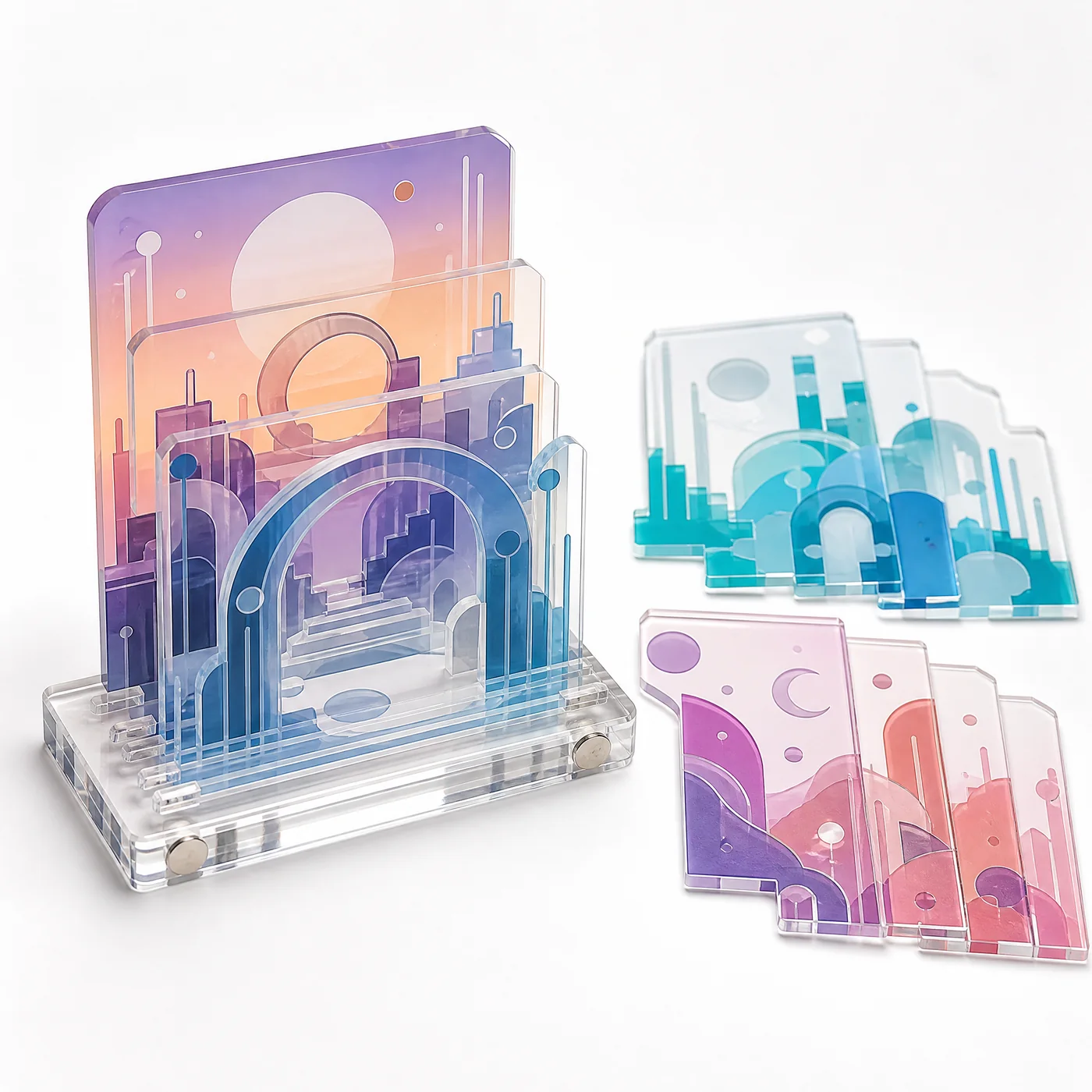
Slot depth is registration, and registration is the whole trick
Each layer sits in its own slot, and the slots are not the same depth. The front slot is shallow, the back slot is deep, and the difference is what puts the layers at their planned distances. Cut four identical slots and the piece still stands. It just stops reading as a scene, because every layer ends up in roughly the same plane and the shadows that sell the depth never form.
Because the panels are clear, a slot that is a fraction out of position shows as a double outline around whatever sits on the layer behind. You see it before anything is bonded, which is the only useful time to see it. We dry-fit the full stack, look at it from the height a customer will look from, and only then go to cement.
The magnets are there for handling, not for holding the piece upright. Pairs sit at the corners of the plate and in the feet of each layer, so a layer drops into its slot and stays down when the unit is lifted. A layer held only by friction walks up out of its slot after enough lifts. A layer held only by magnets is worse: it can slide sideways and the register is gone.
Three print passes, and the white one nobody sees
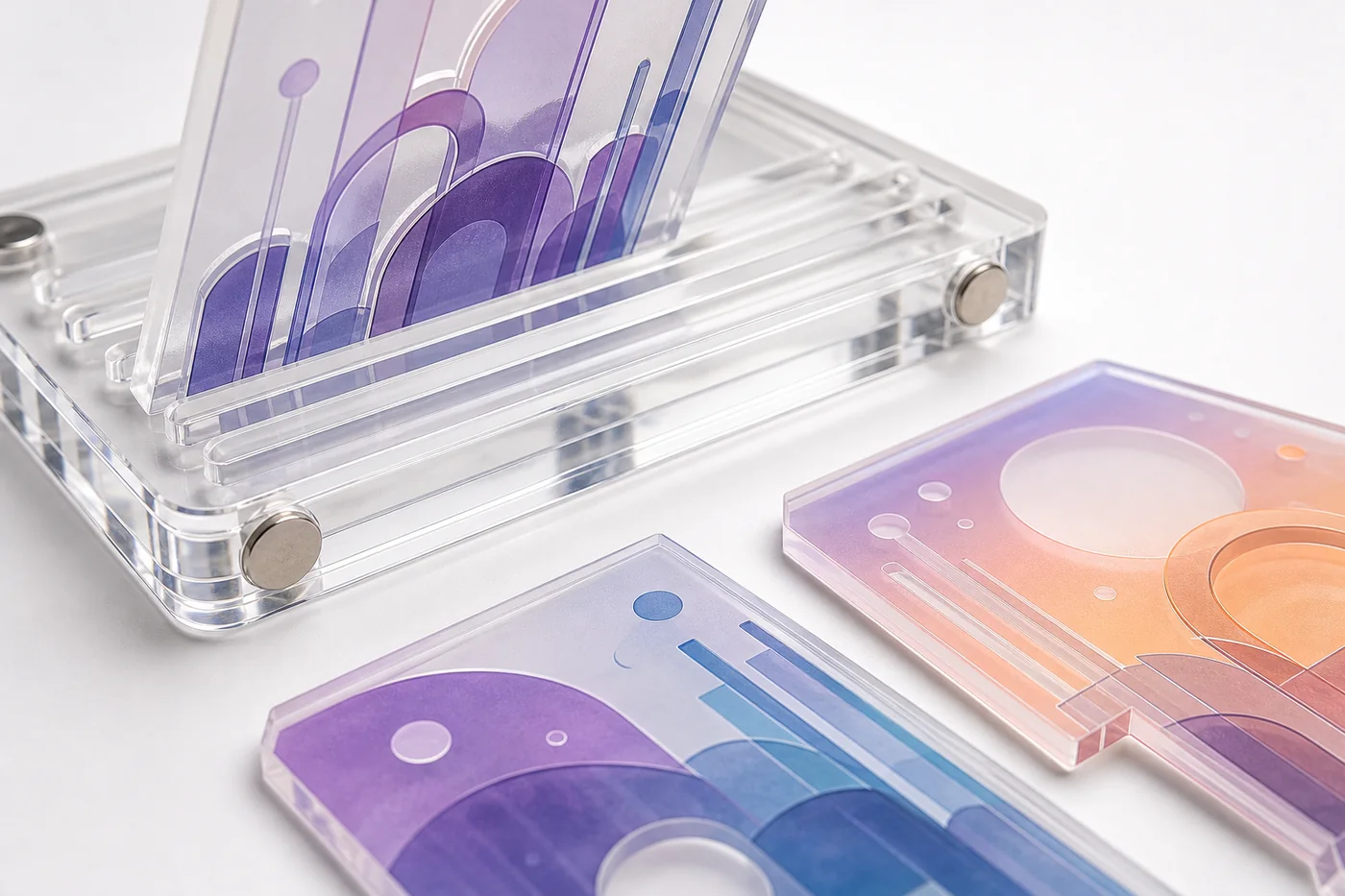
A layer that is printed on one side only looks thin from behind, which matters here because a diorama is viewed through its own layers. So the colour is laid down, then an opaque white pass, then colour again. The white is what makes the panel read solid. Skimp on it and the layer behind shows through the character in front, which reads as a printing fault rather than as depth.
The other pass is a subtraction. Where the artwork wants a glow, we leave the panel clear and let the base light come up through it. Those areas have to be decided at the file stage, because they are the parts that do not get printed. Our lit bases, the same magnetic LED units used on LIGHT-SLOT, drop in underneath without changing the scene.
Frost is the third option and the fussiest. Frosted acrylic diffuses the light nicely and hides fingerprints on the lower layers, where hands go. It also softens the printed edge, so a fine line that reads sharp on clear material turns into a grey smear. Frost goes on the layers carrying background and atmosphere. It does not go on the layer carrying the thing you are meant to look at.
Four layers is a project number
The format runs A5 to A4, and the layer count is quoted per project rather than held at a fixed number. Four is where most series land. Each extra layer is another cut path, another print pass, another registration to hold and another slot depth to get right, so the count follows the artwork. A scene with a strong subject, one mid-ground prop and a flat backdrop works at three. A scene where three things overlap in the same plane works at none of them until someone redraws the separation.
Where this is the wrong object
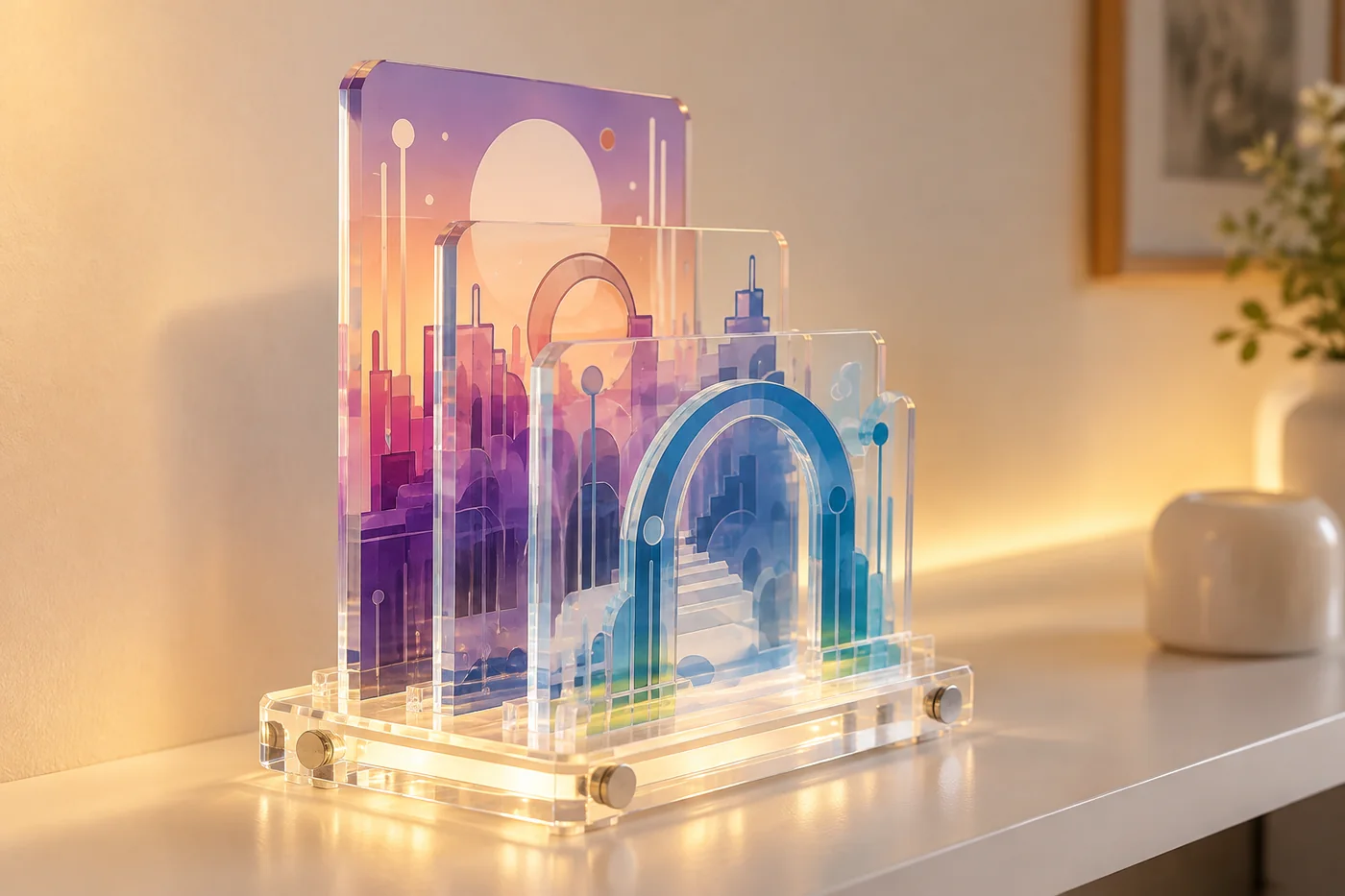
Two clear cases. If the artwork has no separable planes, a shared base will not invent them. And if the job is protecting a set of figures from dust, this is a display, not an enclosure: layers stand in open slots and the assemble has no lid. A closed case does that job; a diorama does not.
The other limit is honest and commercial. A shared base only pays back if a series actually runs. For a single piece, a scene-specific base is cheaper, because you are not carrying the weight of a plate designed for four scenes you have not drawn yet.
What to send for a SCENE-SWAP quote
- The layered file, with subject, mid-ground and background on separate layers where the artwork allows it
- How many scenes the series will run, even roughly, since that is what justifies the shared plate
- Format: A5 or A4, and the height the piece should stand
- Which areas should glow, and whether the base needs its own light
- Where the piece will stand and how close people get to it
One set buys a sample; a small batch is 30–50 pieces and mass starts at 100. Fifteen days for sampling, 25 for production, both from confirmed artwork and deposit. Everything is quoted per project, and the sample is where the slot depths get signed off. The existing layered range is on the SCENE-LAYER page; for a series brief, use the enquiry form and mark it as multi-scene.