
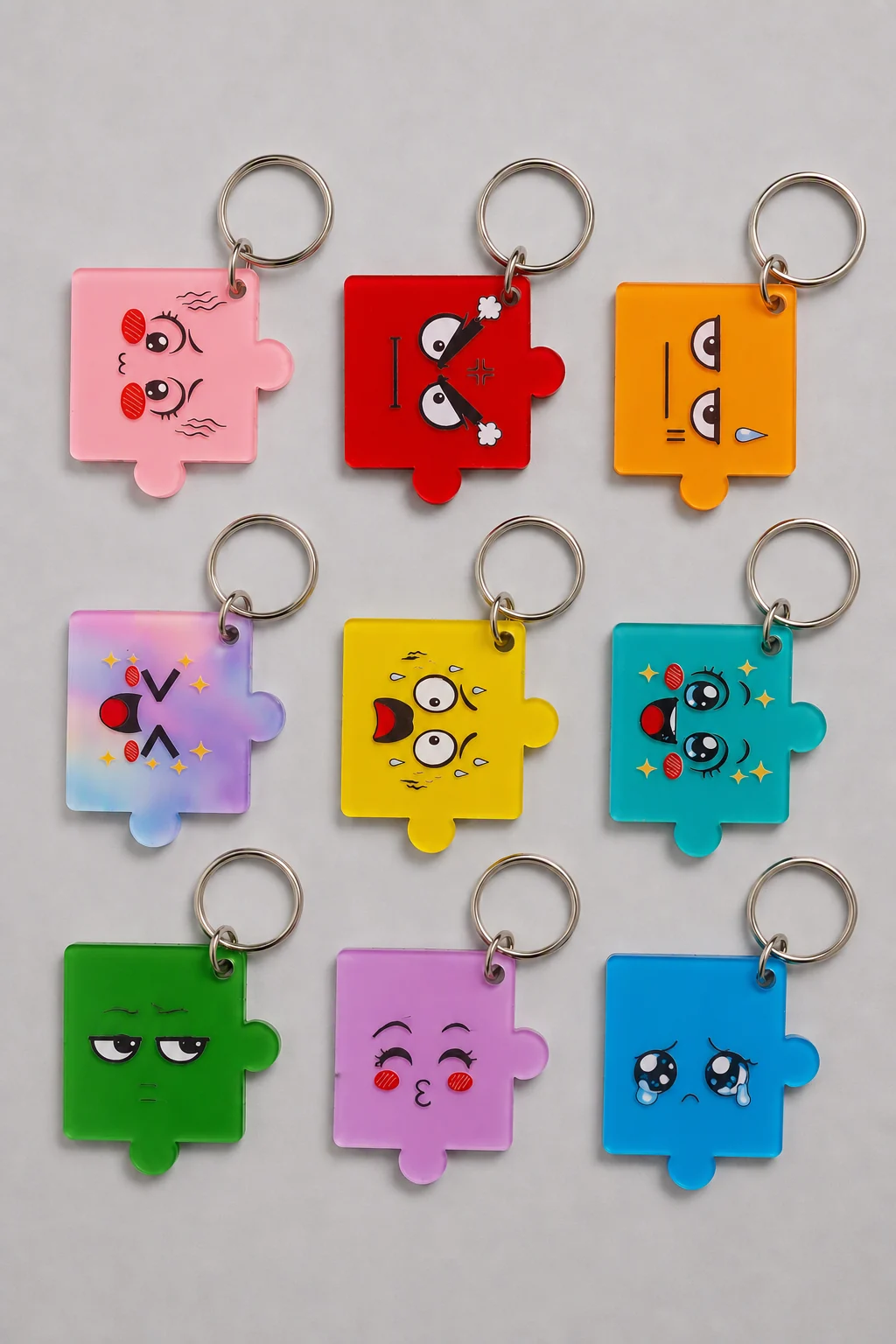
Nine pieces sounds like one product. At packing, it is nine products. Every blind box contains one acrylic keychain, so the buyer can use the piece without owning the other eight. The round hanging hole, printed face and exposed edges all have to look finished on a single piece.
The second use appears later. Collect all nine designs and their tabs and sockets form a 3 × 3 square. Small magnets sit in the acrylic edges. They pull neighbouring pieces together while the jigsaw profile controls where the edges meet. The magnet attracts. The cut line locates.
The blind box must not make one piece feel incomplete
A connected picture is useful for collecting, but it can create a bad single-box product if too much information is carried across a seam. We keep the front faces independent: sleepy, excited, crying, angry, nervous, kissing and other expressions still read when they are viewed one at a time. A customer does not need the centre piece before the first purchase makes sense.
There are nine front designs and nine box outcomes. The packaging can conceal which expression is inside, but the acrylic part itself still needs a complete face, one hanging hole and enough clear margin around that hole for the connector loop. This project uses the same front artwork family across the full set; it does not rely on a repeated face with color changes.
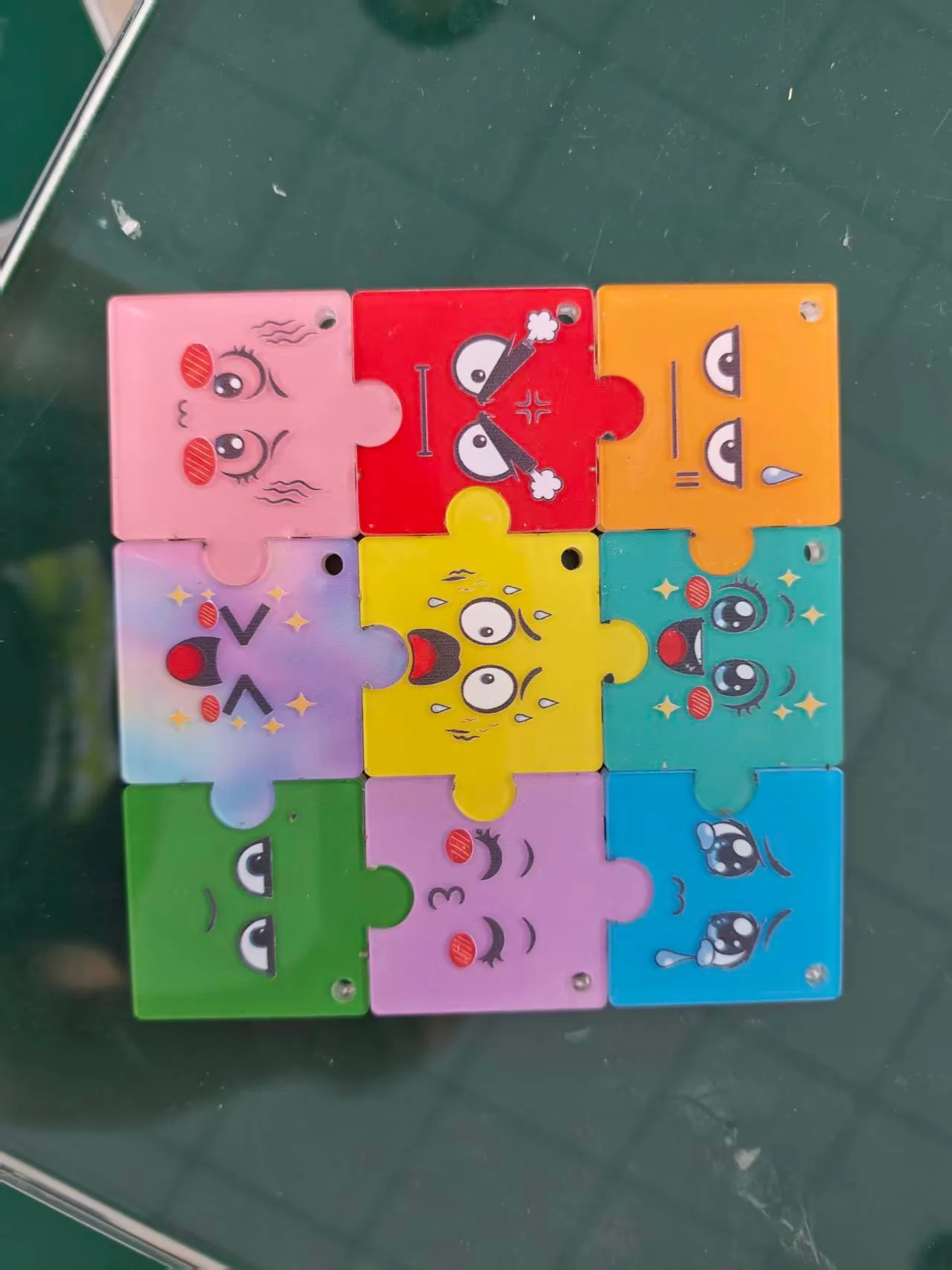
Tabs shape the square; magnets hold the meeting edges
The sample video shows three unfinished pieces on a wooden table. Circular magnets are visible in the exposed acrylic edges. After the pieces are joined, the connected group can be picked up as one assembly. That is a useful bench check, but it is not a strength rating and we do not treat it as one.
Magnet polarity is part of the artwork map. A magnet installed the wrong way does more than weaken one joint: it makes two intended neighbours repel. The practical check is positional. Mark every edge by piece and orientation, dry-fit the set, then verify attraction before the printed faces are signed off.
The reverse artwork has one harder registration problem
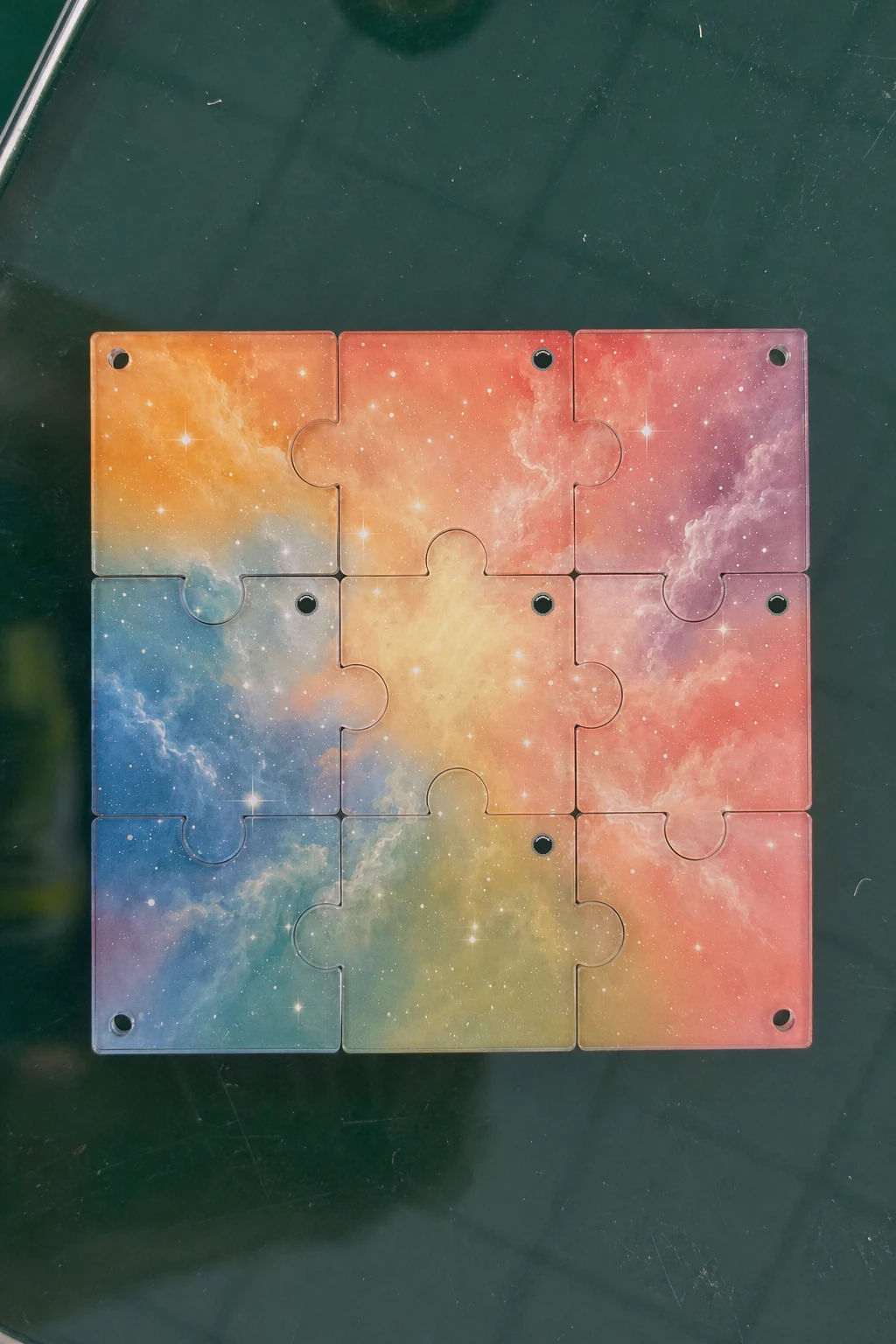
The reverse is a continuous pastel galaxy. Orange and pink clouds run through the upper row, blue moves through the lower left, and pale green reaches the lower centre before the print returns to coral on the right. Nine separate print files still have to become one image when the set is assembled.
A white line at one seam is enough to break the effect. The artwork therefore needs bleed beyond every cut edge, plus a master assembly proof that shows all nine pieces in their final positions. The hanging holes also remove part of the image. Important stars and cloud boundaries should not depend on the small circles that will be drilled for hardware.
One key ring per piece changes the edge layout
The ring is not an afterthought. Its hole competes with three things: the edge magnet, the printed face and the nearby puzzle curve. Move it too close to a corner and the remaining acrylic bridge becomes narrow. Move it inward and the metal connector sits over the face. Put it beside a magnet and the two operations compete for the same edge area.
On a nine-design set, that conflict changes from piece to piece because tabs and sockets move around the perimeter. The sensible method is to check all nine hole positions on the assembled map, then check each piece again in isolation with its connector loop and split ring fitted. A clean square with unusable keychains is not a finished product.
What the sample proves, and what it does not
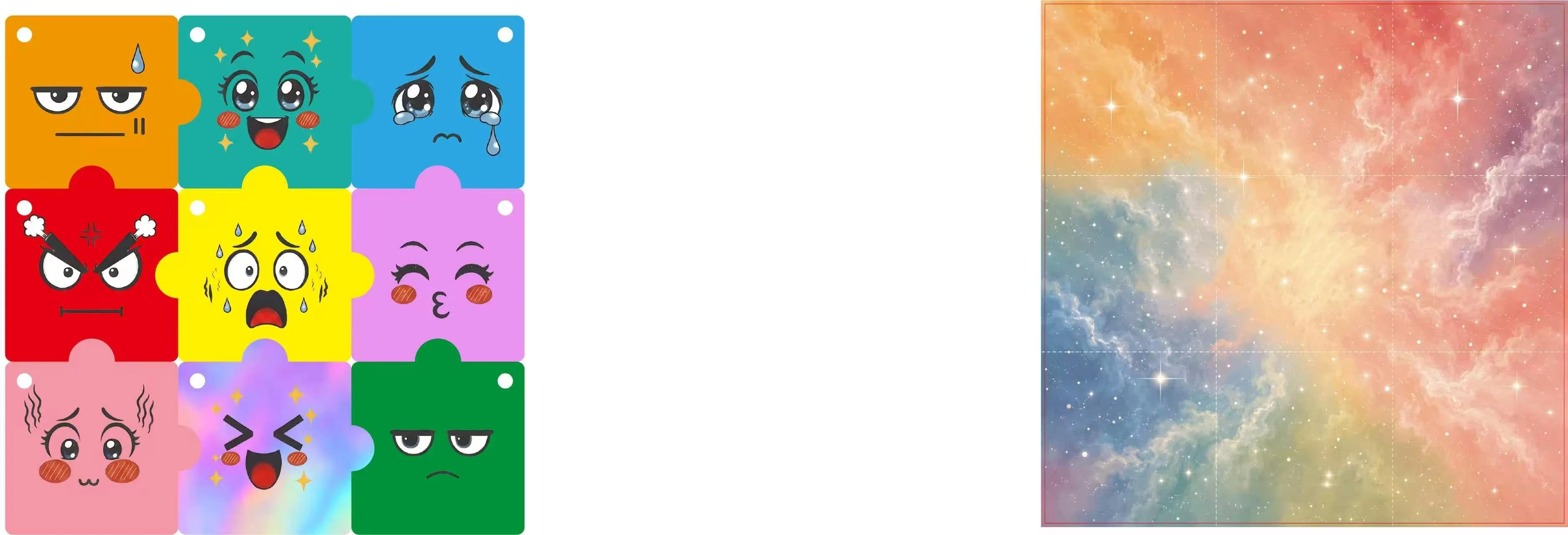
The physical pieces prove the basic proposition: acrylic can carry the jigsaw shape, the edge magnets can connect neighbouring parts, and the assembled square is understandable without a frame. The front sample also shows the nine expressions together. Those observations are visible in the supplied material.
The material does not provide a confirmed acrylic thickness, magnet grade, pull-force figure, finished key-ring specification, blind-box packaging structure, MOQ or production lead time. We have left those numbers out. They belong in a production specification after a finished sample has been tested, not in a caption written from a prototype video.
What to send for a custom magnetic keychain set
- The number of blind-box designs and whether any outcome is a hidden edition
- Front artwork for every individual piece and one assembled reverse artwork file
- The intended puzzle arrangement, including piece orientation
- Preferred key-ring and connector style
- Packaging artwork, warning text and target market language
- A sample-test requirement for magnet retention and repeated assembly
Send the set map and artwork through our project enquiry form. For other ways to organize pins, cards and acrylic merch in one system, see MERCH-GRID, or read how we plan replaceable themed parts in our themed display stand workshop note.