
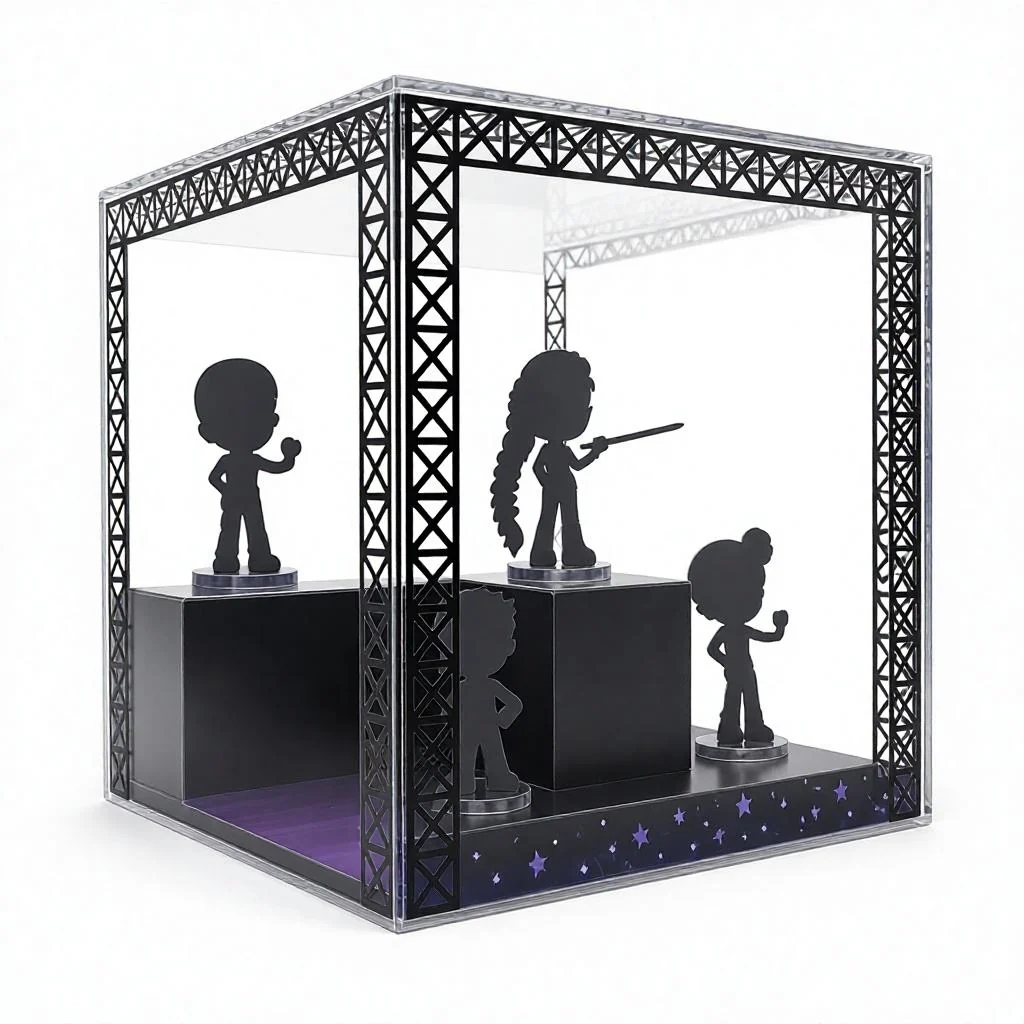
Most clear cases disappear on purpose. This one does the opposite. A black truss runs around all 4 upper edges and drops at the 4 corners, making a frame inside the transparent shell. The figures do not sit on shelves. They occupy a stage.
That move is unusual because the protective layer and the visual layer are separated. The clear outer panels do the quiet job: they close the top and sides. The black inner frame does the loud job: it marks the edge of the scene, gives the eye a scale reference and makes the box recognisable before any artwork is applied. Change the printed panels and the theme changes. Remove the truss and the identity goes with it.
The frame borrows a language from live events
An exhibition truss means temporary architecture. People know the diagonal members before they know why: concert stages, launch booths, lighting rigs. Shrunk around figurines, that same pattern tells the viewer that something is being presented rather than stored.
The effect depends on repetition. Every span uses the same X-braced rhythm, every corner column continues it vertically, and the inner rear post repeats the line through the clear wall. Break that rhythm with a solid bar and the frame starts to look like a cage. Make the diagonals too fine and they disappear behind dark figures. The listing does not give a rib width, so this article does not invent one. That is a sample decision, checked at normal shelf distance after the figure silhouettes are placed.
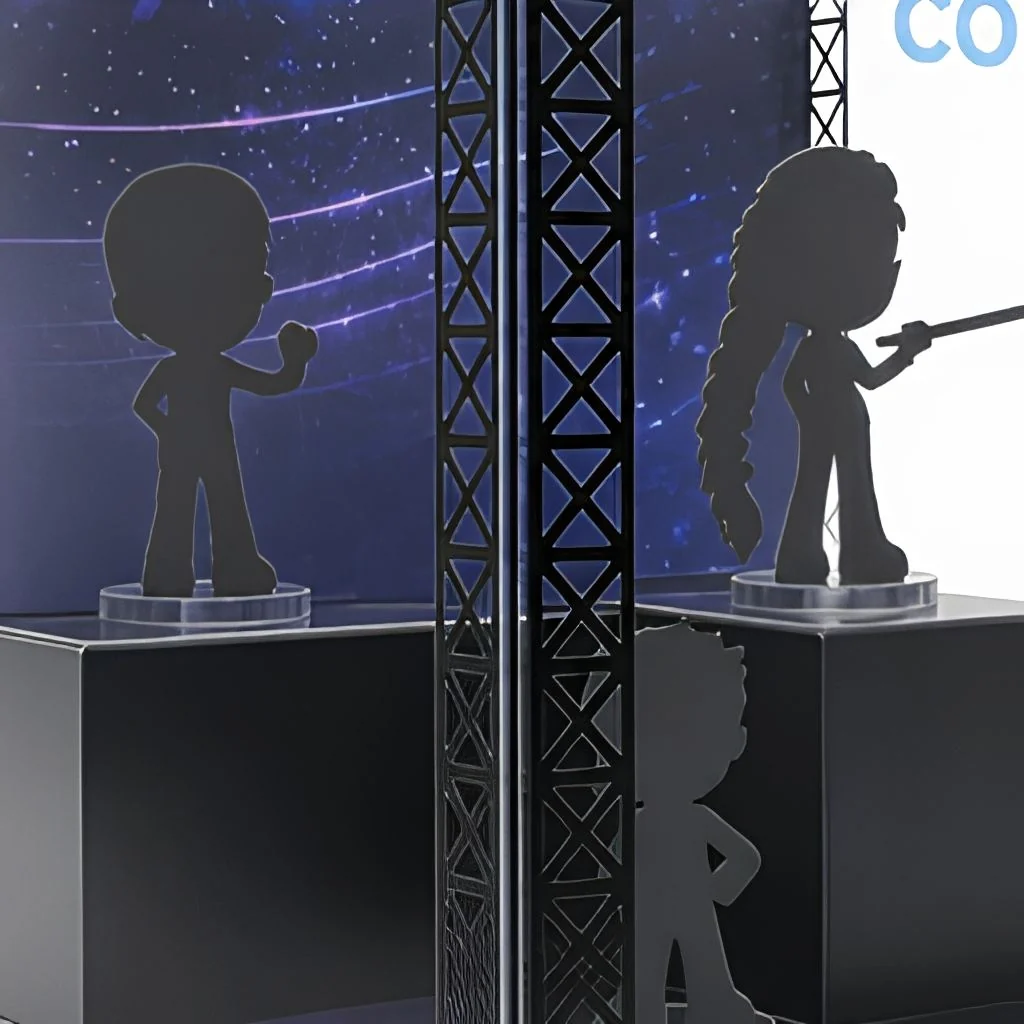
Three levels solve four figures
4 characters occupy 3 heights. The front-right figure sits at floor level. 2 figures stand on separate blocks behind it, and a fourth appears between them on a lower clear base. No row is complete, so the eye moves diagonally across the case rather than reading it as a product shelf.
The stepped stand is built into the display concept. It is not loose riser furniture added after the enclosure is made. That matters at reset: a loose cube shifts when the case is cleaned; a fixed plinth gives each figure a repeatable place. It also sets a hard limit. A buyer cannot change from short blind-box characters to tall 1/6 figures without reworking the sightlines and possibly the shell. The figure list comes before the cutting file.
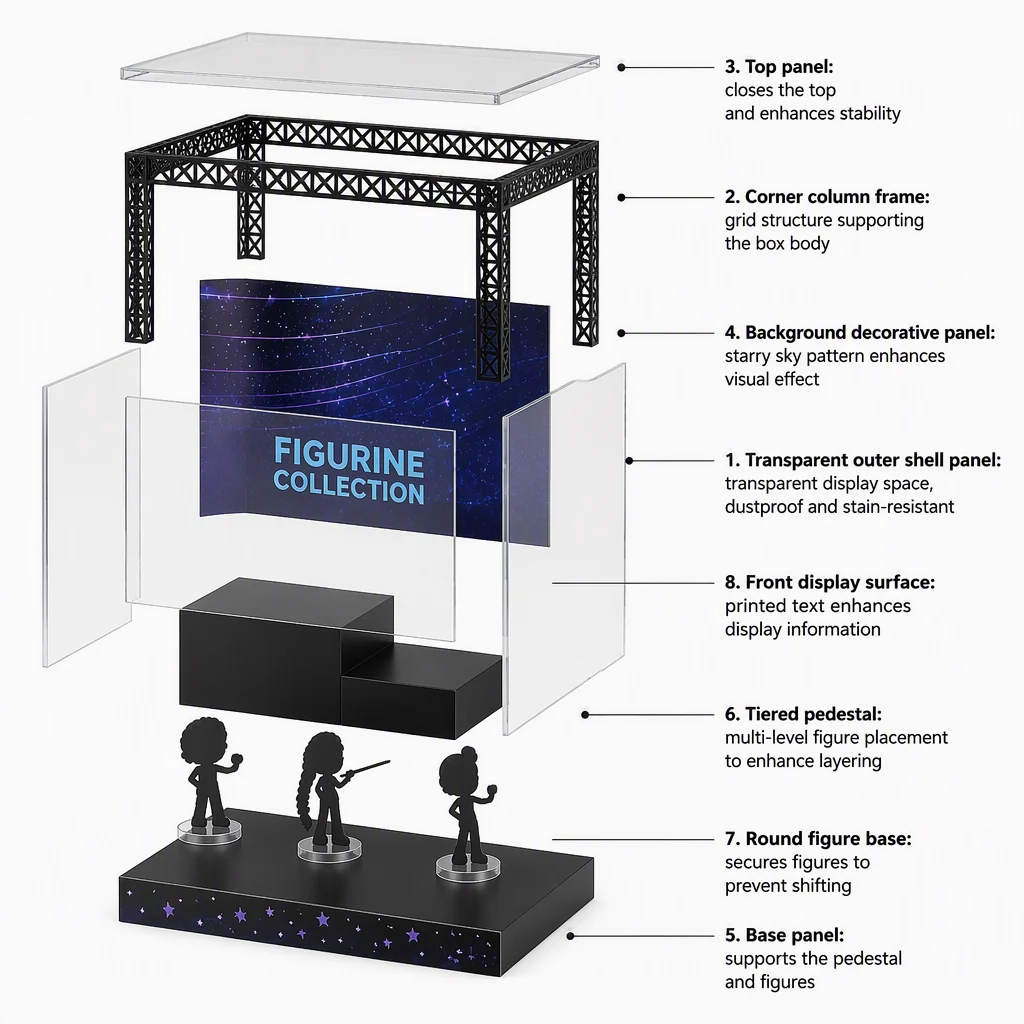
Eight visible parts, five actual operations
The exploded illustration names 8 parts: outer panels, corner frame, top, printed background, base, tiered plinth, round figure bases and a front graphic surface. 8 parts do not mean 8 independent products. They collapse into 5 fabrication operations: sheet cutting, frame and base assembly, artwork printing and lamination, final enclosure assembly, then a display check with figures installed.
The design earns its complexity because each operation changes what the viewer sees. The top closes the case. The frame supplies the silhouette. The rear print establishes atmosphere. The steps separate heights. The front strip covers the dead zone below the figures. If a part cannot explain its job that clearly, it is decoration carrying cost.
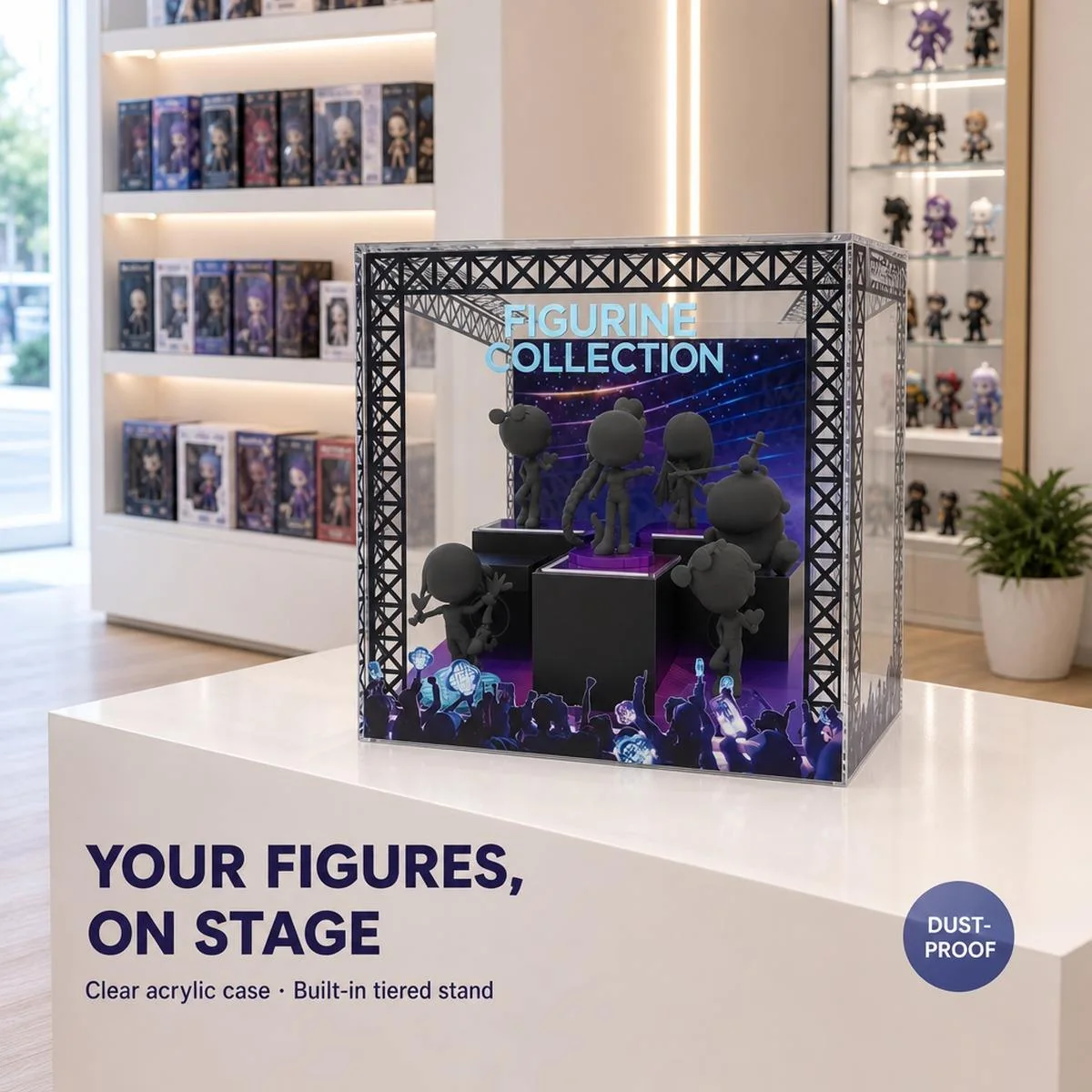
Clear shell outside, printed world inside
The shell stays transparent while colour is concentrated on the rear and lower front panels. That is a controlled use of print. Cover every wall and the case becomes a carton; leave every wall blank and the truss floats without a setting. Here the rear galaxy gives the figures a field, while the purple floor and star strip carry the scene to the front edge.
The attribute sheet specifies UV digital printing and says artwork, size and logo can be customised. That does not tell us whether the print is direct-to-acrylic, on a film or on a separate insert for every order. One listing production panel shows colour printing followed by lamination, so this example is best treated as a protected printed insert until the sample drawing says otherwise. Print method matters because an insert can be replaced; direct print cannot.
The design fails at the seams
Transparent panels reveal every joint behind them. At the front corner there are 3 lines to reconcile: the acrylic edge, the black column and the printed floor strip. Let one lean by 2 mm and the error remains visible from top to bottom. The frame cannot be glued in by eye after the shell is closed. Its datum has to come from the base.
The same problem appears at the roof. The top sheet closes over the horizontal truss, so a proud glue bead or a bowed beam produces a dark line under a clear lid. The five-step listing graphic includes a final check for stability and transparency. That is the right order: check the empty enclosure under raking light before the figures and graphics hide the faults.
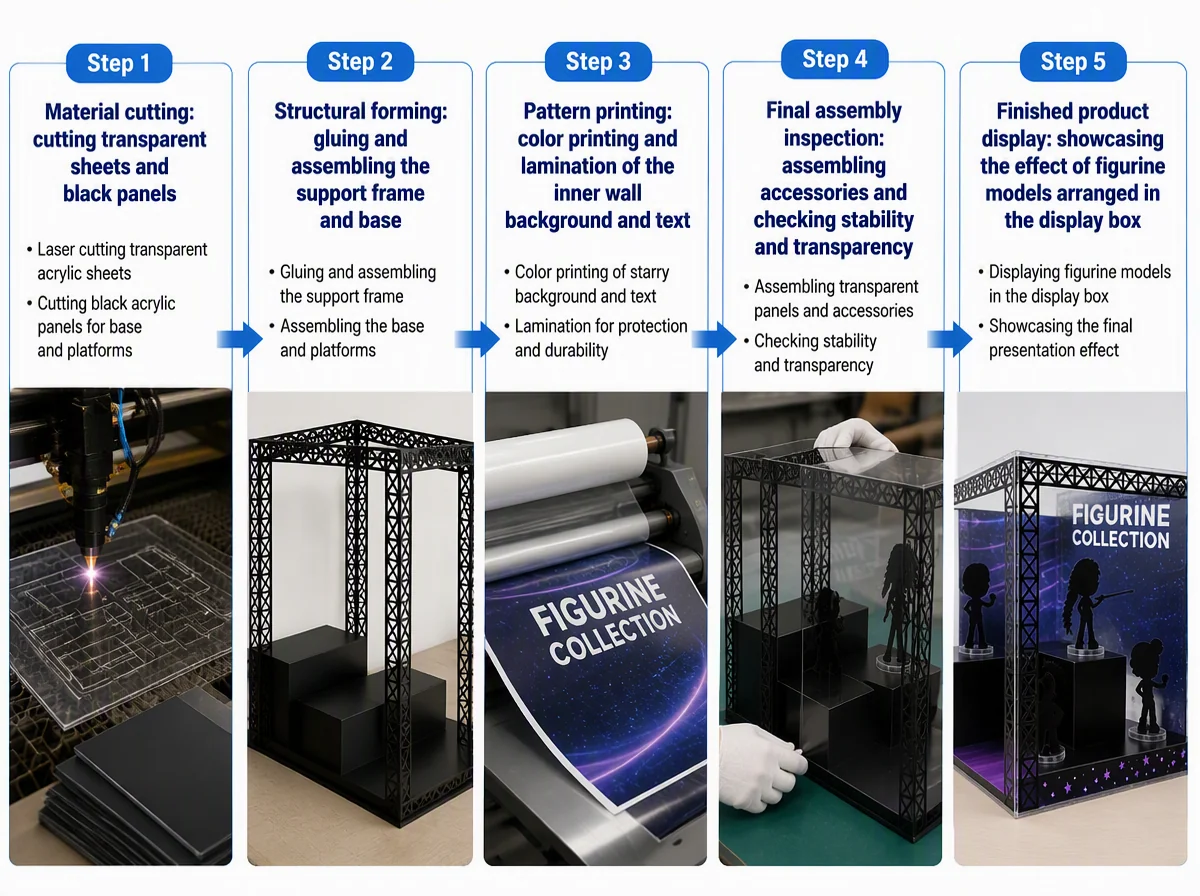
What is confirmed, and what is still a drawing decision
Confirmed from the product record: a transparent acrylic enclosure, an integrated tiered stand, UV digital printing, freestanding vertical use and custom artwork, size and logo. The record does not confirm panel thickness, joint type, finished dimensions, magnet grade, load per step, MOQ or lead time. Those numbers stay out of this article.
It also calls the case dustproof. A closed top and sides reduce direct dust fall, but the listing does not show a tested seal or give an ingress standard. We would specify it as an enclosed display case and inspect the panel gaps on the sample. "Dustproof" is a claim; a gap drawing is evidence.
What makes it unique is a reusable grammar
The design is not unique because it has galaxy artwork. Galaxy artwork can be changed in an afternoon. Its identity comes from a 3-part grammar: truss around the transparent volume, unequal black plinths inside it, and colour held to the rear and bottom edges. Keep those 3 relationships and a new character set still belongs to the same product family.
That is useful for a retailer planning several launches. The shell and frame can remain the recognisable object while printed panels and figure positions change. It is also where the concept should stop. Adding lights, sound or moving parts would introduce a second idea and a service problem. This case already has one strong sentence. It does not need another.
What to send before this case can be quoted
- Every figure's width, depth, height and weight
- The front, side and top viewing directions
- Which figure must occupy the highest step
- Replaceable insert artwork or direct-print preference
- The permitted outer footprint and maximum packed size
- Whether the case opens for daily handling or stays closed
A front view alone is not enough. Send the tallest figure and the widest figure in side view, plus a rough counter footprint. We can then return a sightline layout before anyone invests in detailed artwork. For related engineering choices, compare our guide to themed figurine display stands, the note on acrylic case thickness, and the MODU-BOX system. Submit the brief through the project enquiry form when the figure list is ready.