
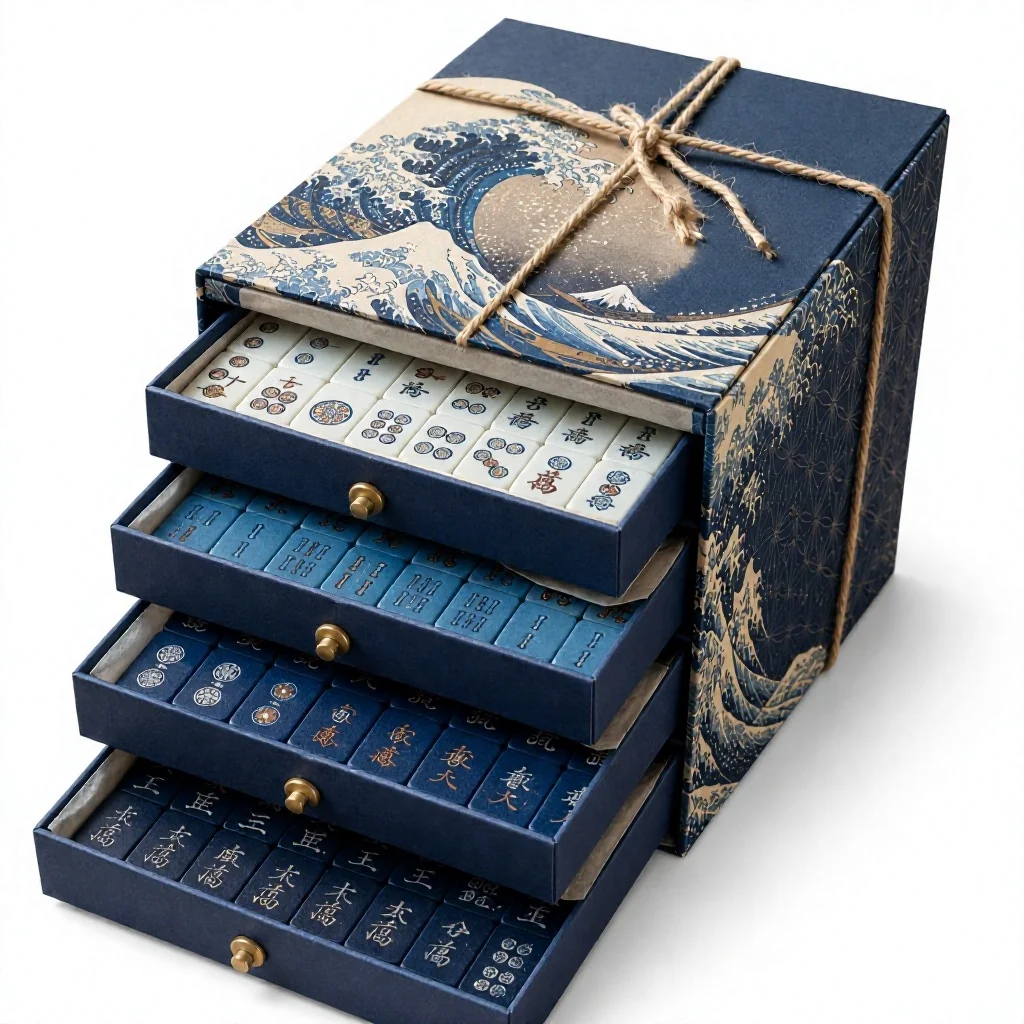
The set is an acrylic mahjong game held in a paper-wrapped drawer box printed with Katsushika Hokusai's Great Wave off Kanagawa. It is listed as an OEM gift item, product ID 1601912707179, and every image on this page comes from that listing's design renders rather than a finished shipment. What follows is a read of the design as a manufacturing brief: what the print demands, where the drawers will bind, and which claims a buyer should hold until a sample lands on the desk.
The print lands on three faces at once
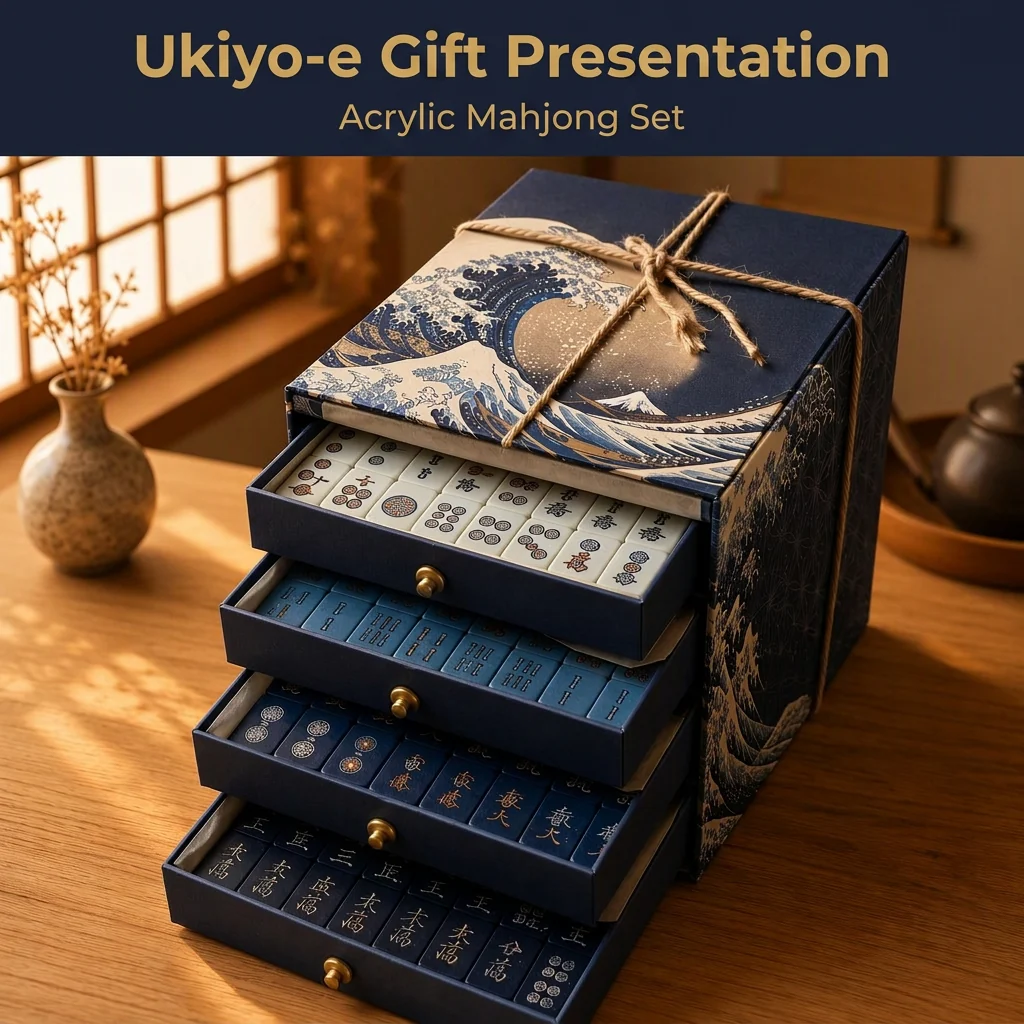
A folding carton is printed as one flat sheet that becomes a box afterwards. A drawer box is a different problem. The wrap goes onto the lid, onto the fixed front panel that sits under the lid, and down the right-hand side. Three separate pieces, wrapped separately, and the wave has to continue across both joins.
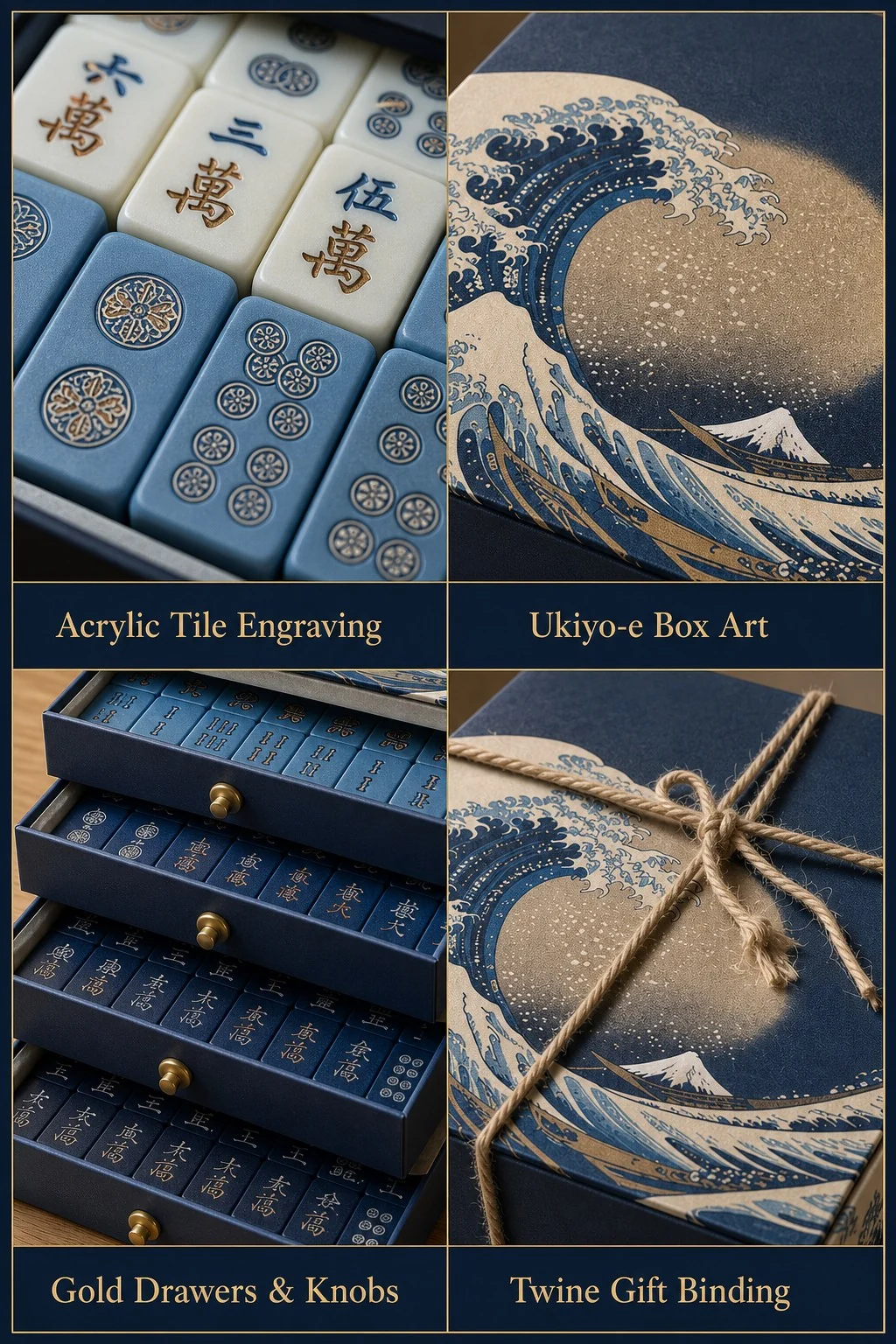
On the lid sits the crest, breaking into clawed foam. On the side panel the water falls away and Fuji sits low in the trough. A side wrap that shifts by a millimetre during assembly breaks the line of foam at the corner, and the eye finds that break before it finds anything else on the box. This is the one tolerance on the whole product that cannot be rescued by a gasket, a thicker panel or a better label.
The four drawer fronts are deliberately left plain. Pattern stays on the static shell; the moving trays stay navy, with one knob each.
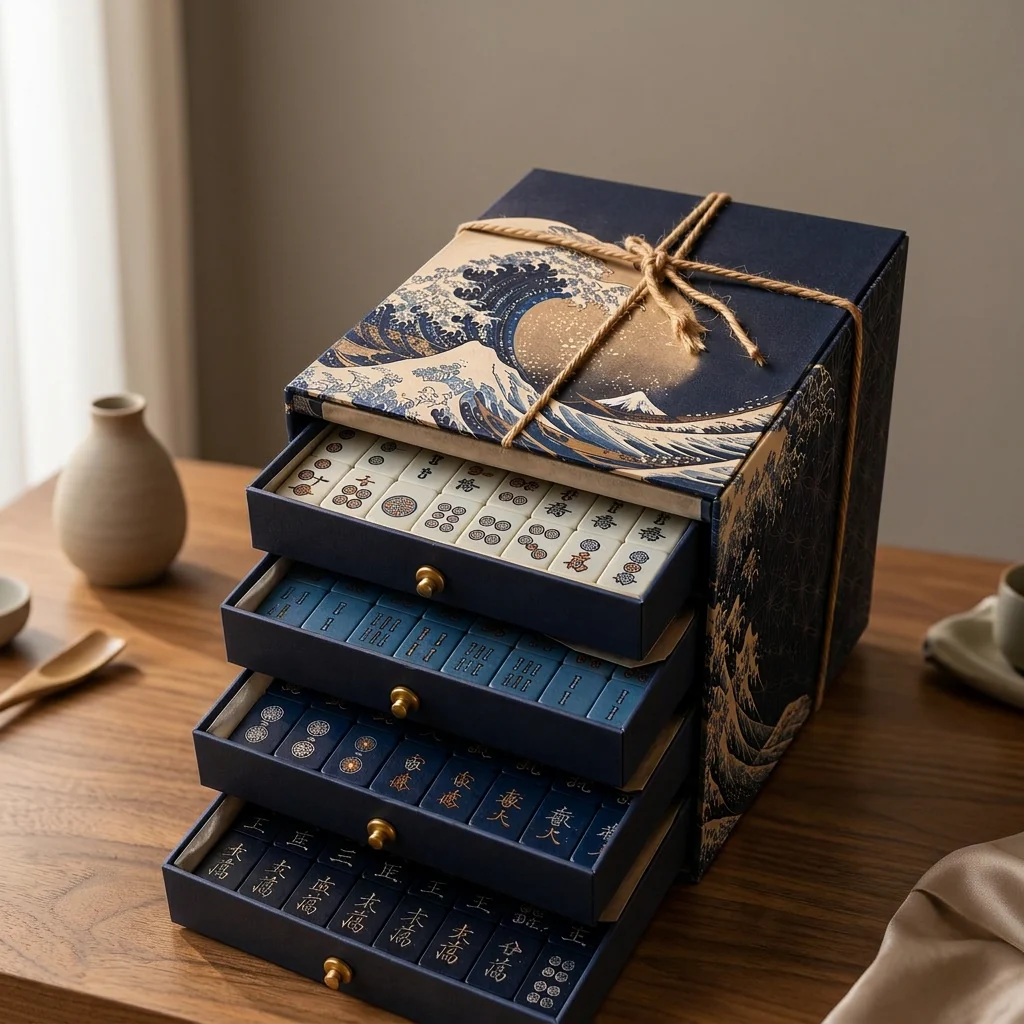
Four centres of pull, four ways to bind
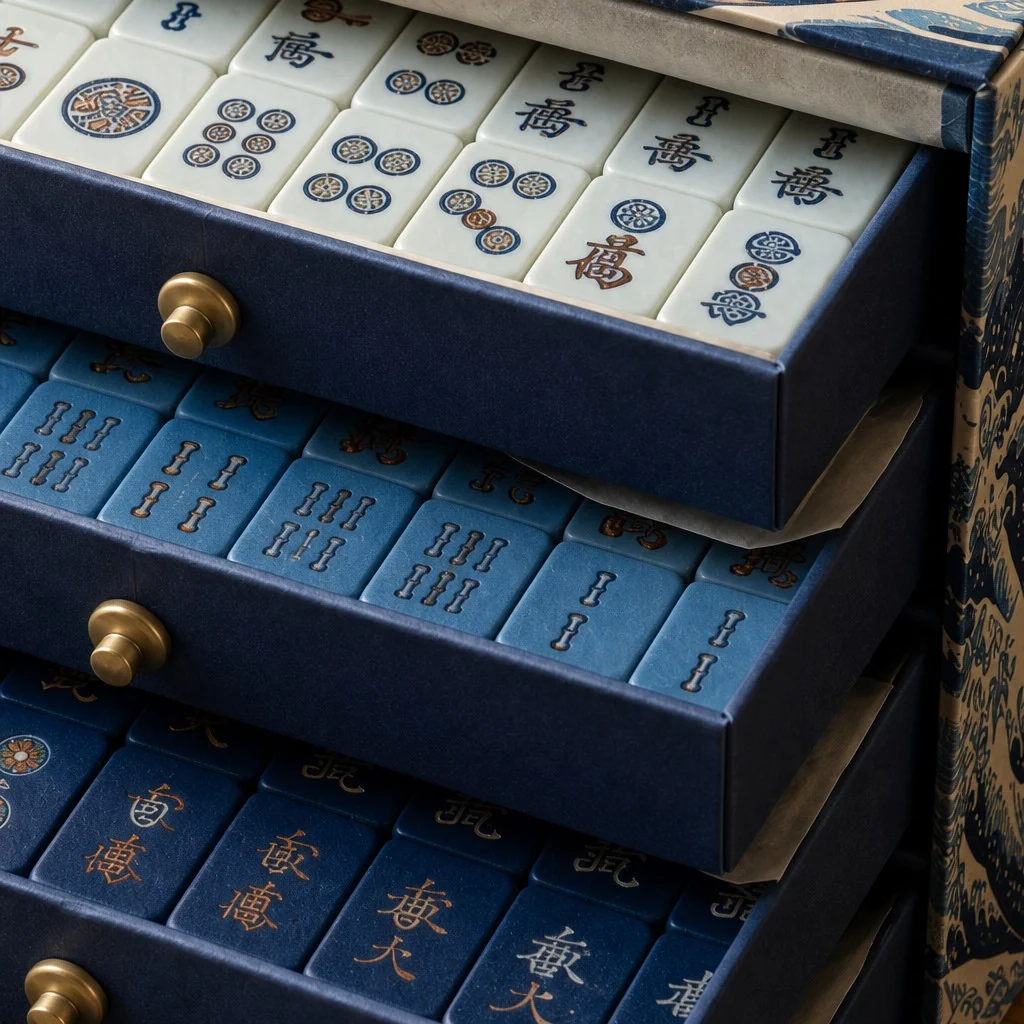
Each tray is a shallow open box that slides out of a fixed carcass, and each front carries a single knob in the centre. That looks calm and behaves badly if the runners are not parallel, because one offset knob cannot correct a side that binds. The front rotates a degree or two and the corner scrapes the carcass on the way out.
Two things prevent it. The runners are fitted with a slight, even clearance instead of a snug fit, and each front is set a fraction proud of the carcass so the wrapped paper edge never rubs.
Wrapping order matters more than it sounds. The paper adds thickness to every tray, so the carcass is cut to the wrapped size, not the bare board. Cut the carcass first and the last drawer will not go in.
The tie is a single length of jute, knotted on top. It holds the lid down and it is the first thing a recipient touches. Retail staff will re-tie that knot after every demonstration, so it has to hold tension after being undone and redone, and the paper underneath has to take the abrasion without going fuzzy. A sample opened thirty times is a different object from a sample opened once, which is why we would ask for both before approving a run.
Two tile colourways, doing two different jobs
Tiles come in two colour families within the same set: ivory faces marked in blue, and deep navy tiles with a gold-tone fill sitting in the engraved lines. The split is functional before it is decorative. Characters and suits can be sorted and read across a table by colour, which matters at the pace a real game moves.
Engraving is a small decision with a long tail. The line has to be shallow enough to fill cleanly and deep enough that the fill does not wear off at the edge of a stroke, and every stroke in a character has to reach the same depth or the fill pools. Filled grooves also collect dust, which is invisible on navy and noticeable on ivory.
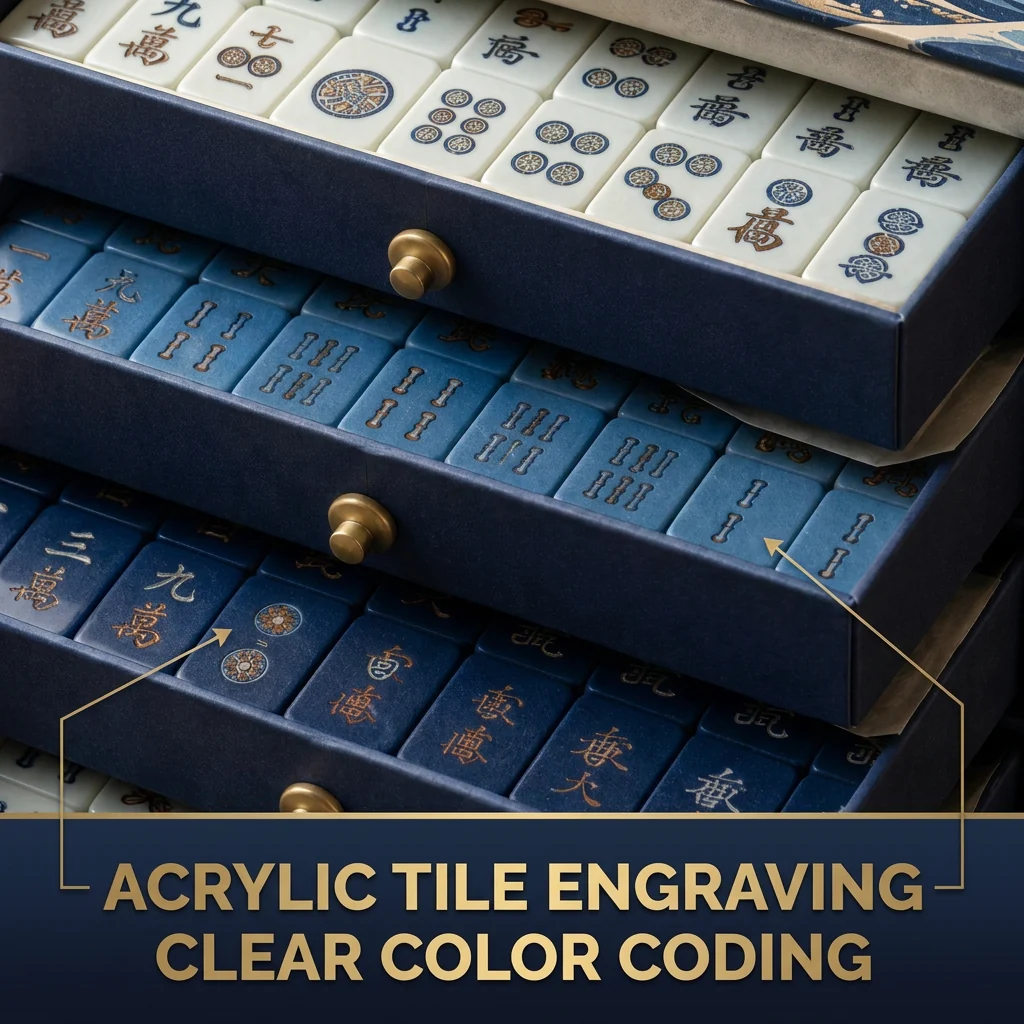
Contrast deserves a test rather than an assumption. Under warm restaurant light the gold fill holds at table distance. On a dim shelf it reads as texture instead of symbols, and a player who cannot name a tile quickly will not use the set twice. If the order is going to a venue rather than a home, get the faces checked in that venue's own light before the artwork is locked.
The box is the gift argument
Buyers ask what makes a mahjong set a high-end gift. In this design the honest answer is the packaging, because it is the only part the recipient sees before they know what the object is. A printed shell under a tied lid does the job a logo usually does: it signals that someone chose this rather than ordered it in bulk.
That makes the branding question easier. One mark inside the lid and one on the sleeve is usually enough. The wave already carries the visual weight, and a second logo printed across the tile faces fights it while making the game harder to read.
Two commercial facts from the listing are worth writing down. It is quoted from 50 sets, and the package record puts a set at 2 kg packed. The weight decides whether the box travels in a mailer or needs a moulded insert and corner protection. The 50-set minimum is roughly the size of one small corporate order or a single retail shelf, which is the scale this item suits.
Where the design stops working
It is a gift box, not a display case. There is no window, no dust seal and no UV block. Once the lid is off the tiles are exposed, and a set left on a coffee table will collect dust in the engraved lines within a month. Buyers who want the set visible between games should be pointed at a different product rather than sold this one.
Corner wear is the other predictable failure. A paper-wrapped box with square corners takes impact exactly where the wrap is thinnest, and a 2 kg object in transit finds those corners. Protect it deliberately or replace it twice.
| Failure point | What it looks like | What prevents it |
|---|---|---|
| Wrap seam at the lid corner | Foam line breaks by a millimetre; the print no longer reads as one image | Wrap the side panel first, then register the lid against it |
| Single-knob drawer | Front rotates on pull, corner scrapes the carcass | Even runner clearance, front set slightly proud, carcass cut to wrapped size |
| Engraved tile fill | Colour wears off the top edge of a stroke; dust settles in the groove | Consistent engraving depth, fill below the surface, a cleaning note in the box |
| Paper wrap in humidity | Drawer fronts bow out of line before the carton is opened | Moisture barrier in the export packing for wet-season destinations |
What the renders do not prove
The renders show intended appearance, not specification. They do not establish the tile count, the acrylic thickness, whether the drawer fronts are wrapped board or acrylic, how the gold fill is applied, or how the print survives a corner drop. The knob tone in particular is a sampling question: a light brass look can be plated zinc or solid brass, and the difference shows on the second handling, not the first.
Colour needs the same discipline. Navy printed on coated paper shifts under warm light, and the tile fill shifts further than the box does. An approval taken from a screen should be repeated under ordinary room light before the run is released.
Send these details for a quoted sample
- Occasion and recipient count, since a 50-set run and a 300-set run are different projects
- Destination market and shipping mode, so corner protection and moisture barrier are quoted together
- Wrap artwork and written confirmation that it is your own or free to use
- Tile format for the market, because markings differ by region
- Logo placement preference, and confirmation that no third-party mark will be printed
- Whether the set will be displayed between games, because if it will, this is the wrong product
Send the brief through the project enquiry form. For the lit version of the same category, read our notes on the light-up mahjong gift set; the acrylic mahjong collection and the acrylic gifts collection cover the rest of the range.