
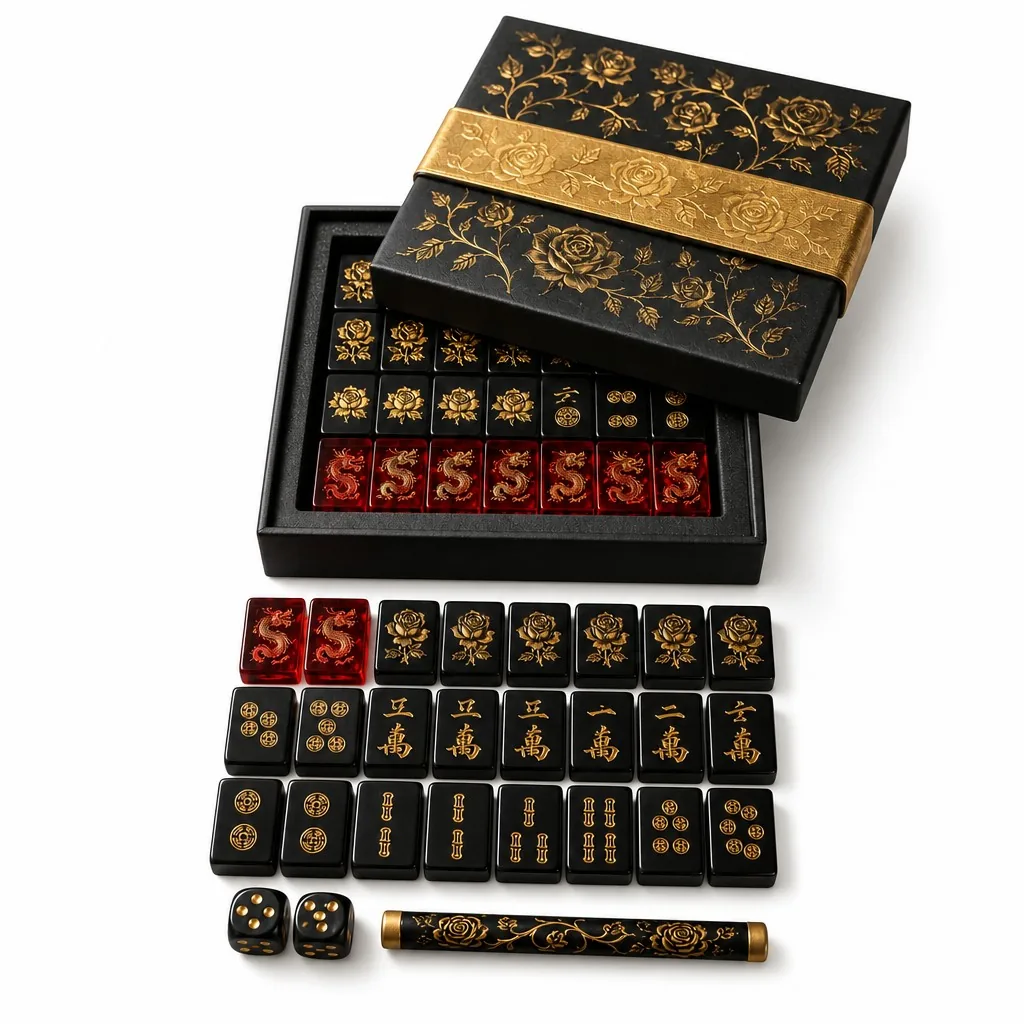
This is an acrylic mahjong set finished in black and gold: rose relief engraved across the backs of the character and circle tiles, translucent ruby tiles for the dragons, a rose-patterned gift box closed with a gold band. It is listed as an OEM gift item, product ID 1601914155216. The listing carries six design renders and no photograph of a finished shipment, so what follows treats the images as a manufacturing brief rather than a product description: what each choice costs, and which claims to hold until a sample is on the table.
Black is a surface that keeps a record
The tile body is opaque black. That is the whole design idea and also its main liability. On a gloss black surface, a scuff of 0.1 mm lifts the top layer of polish and reads white under raking light. Hold any black acrylic at about 45 degrees to a window and the scratches show up as a haze that was invisible from the front.
There is a fix, and it has a price. A semi-matte body hides handling marks well and dulls the gold: the engraved rose sits in a field that no longer throws light back, so the fill has to carry the whole effect on its own. A gloss body makes the gold sing and shows every print. For a set that will actually be played, we would argue for semi-matte and put the shine into the fill instead of the substrate. For a set that will sit in a box and be photographed once, gloss is fine.
Finger oil behaves the same way. The flat black field between the roses shows a thumbprint from across a table; the gold fill hides it. So the part that gets touched most is the part that looks worst, which is worth knowing before someone writes "wipe with any household cleaner" into the care note.
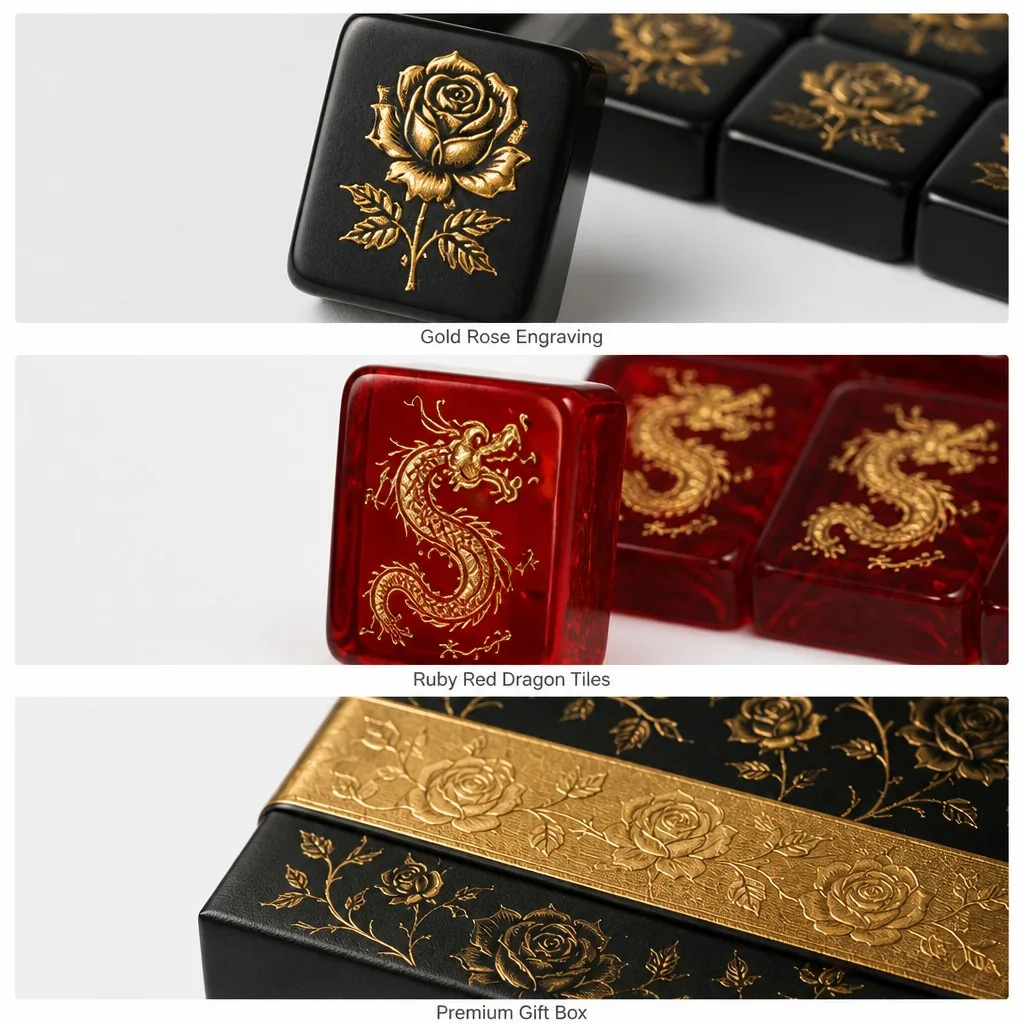
The rose is the hardest line on the tile
A rose is not one line, it is a set of near-parallel curves that converge at the petal tip. That convergence is where engraving either closes cleanly or muddies into a dark blob. Circles and characters forgive a tenth of a millimetre. A rose does not, because the eye reads the petal edge as an edge and any thickening turns a flower into a smudge.
Engraving depth is a narrow window. Too shallow and the fill sits on the surface with nothing to hold it, so it wears at the stroke edge first. Too deep and the fill pools in the wide parts of the petal while the thin parts stay starved. Every stroke in the motif has to reach the same depth, which means the artwork has to be prepared for the process before it reaches the machine: hairlines opened up, the smallest gaps between petals widened.
| Fill method | How it reads on black | Where it fails |
|---|---|---|
| Paint fill, wiped below the surface | Warm gold, low glare, closest to the render | Wears at the stroke edge; needs a top coat that survives cleaning |
| Metallic foil, pressed into the groove | Sharpest highlight, strongest at distance | Lifts on bevels and corners; small areas only |
| Laser frost, no fill | Grey against black, texture rather than symbol | Nearly invisible at 60 cm on a dim table |
The render on the listing looks like option one. It could equally be a render of option two. That distinction only matters after a shuffle test, because a filled groove is judged at the petal tips, not in the middle of the flower: 200 shuffles on a hard table, then look at the thinnest stroke first. If the gold has gone at the tips, the fill is sitting on top of the engraving rather than in it.
Two colour families doing one job
The set splits into black tiles and ruby ones. The ruby is reserved for the dragon tiles, which is a functional decision before it is a decorative one: at the speed a real game moves, a player sorts by colour and shape, not by reading every character. Giving the dragons their own material means a hand can be scanned without counting strokes.
Translucent pigmented acrylic is harder to keep clean than opaque. Light passes through it, so internal flow lines and trapped bubbles that would be invisible in black become visible in ruby, and the reject rate on the ruby pieces will always be higher than on the black ones. Translucency also changes colour with the table under it: on a dark felt the ruby reads almost black, and on a pale cloth it glows. If the set is going to a venue, check it in that venue's own light before the colour is signed off, because a ruby that loses its glow is just a dark tile with extra cost attached.
The band covers the seam, so the pattern has to survive the join
The box is an open tray with a lift-off lid, wrapped in printed black with a gold band running across the top. That band is doing structural work. It sits over the line where the lid wrap meets the tray wrap, so the box never has to show a seam at the front. In exchange, the rose pattern has to continue across the band edge, and a cross-wrap that lands 1 mm out breaks the pattern at the most visible point on the object.
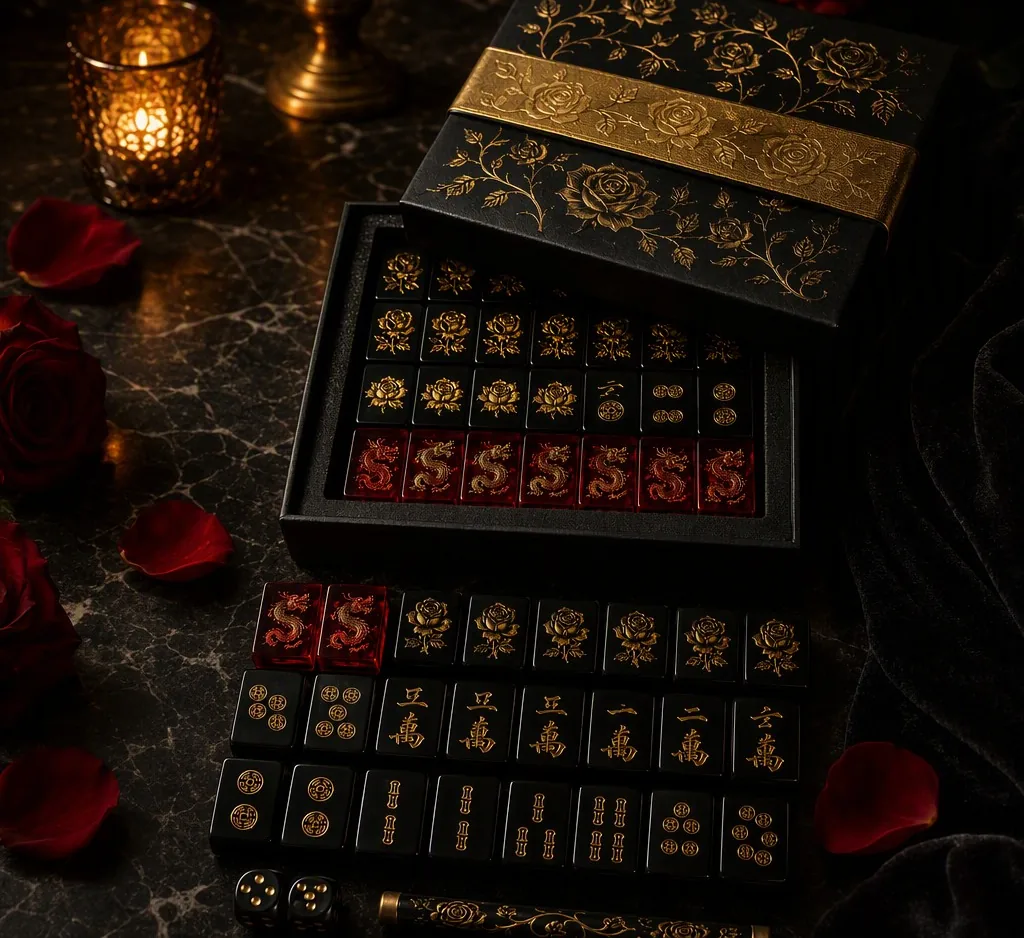
The band's edges are adhesive edges on a curved corner, which makes them the first thing to lift in a humid warehouse. A wrapped box that leaves Shanghai in July and sits in a container for five weeks is a different object from one that leaves in November. If the destination is a wet-season port, ask for the wrap to be checked after a humidity cycle rather than straight off the line.
Compared with a drawer box, this construction removes the moving parts. There is one motion to open it: lift the lid. That is faster to demonstrate in a shop and much harder to jam. It also means there is nothing to fill the moment of opening except the tile layout inside, so the tray insert has to hold the rows straight. A foam or flocked insert cut 1 mm wide lets the tiles shift in transit and the first thing the buyer sees is a set that looks second-hand.
What the renders do not prove
The listing publishes a feature line reading "museum-grade craftsmanship". That is a claim in an attribute table, not a specification, and it tells a buyer nothing they can hold. The renders do not establish the tile count, the tile size, the acrylic thickness, the weight of the set, the engraving depth, or which fill method is used. A standard mahjong set runs to 144 tiles; whether this one ships 144 has to be confirmed in writing rather than inferred from a picture of one open tray.
Weight is the gap that bites commercially. Acrylic is lighter than the melamine and bone sets most players know, and the difference is audible as well as physical: a thinner body gives a higher, drier clack. Some buyers will call that cheap on the first hand, before they have looked at a single rose. Since the listing does not state a per-set weight, export packing cannot be quoted properly from the page alone.
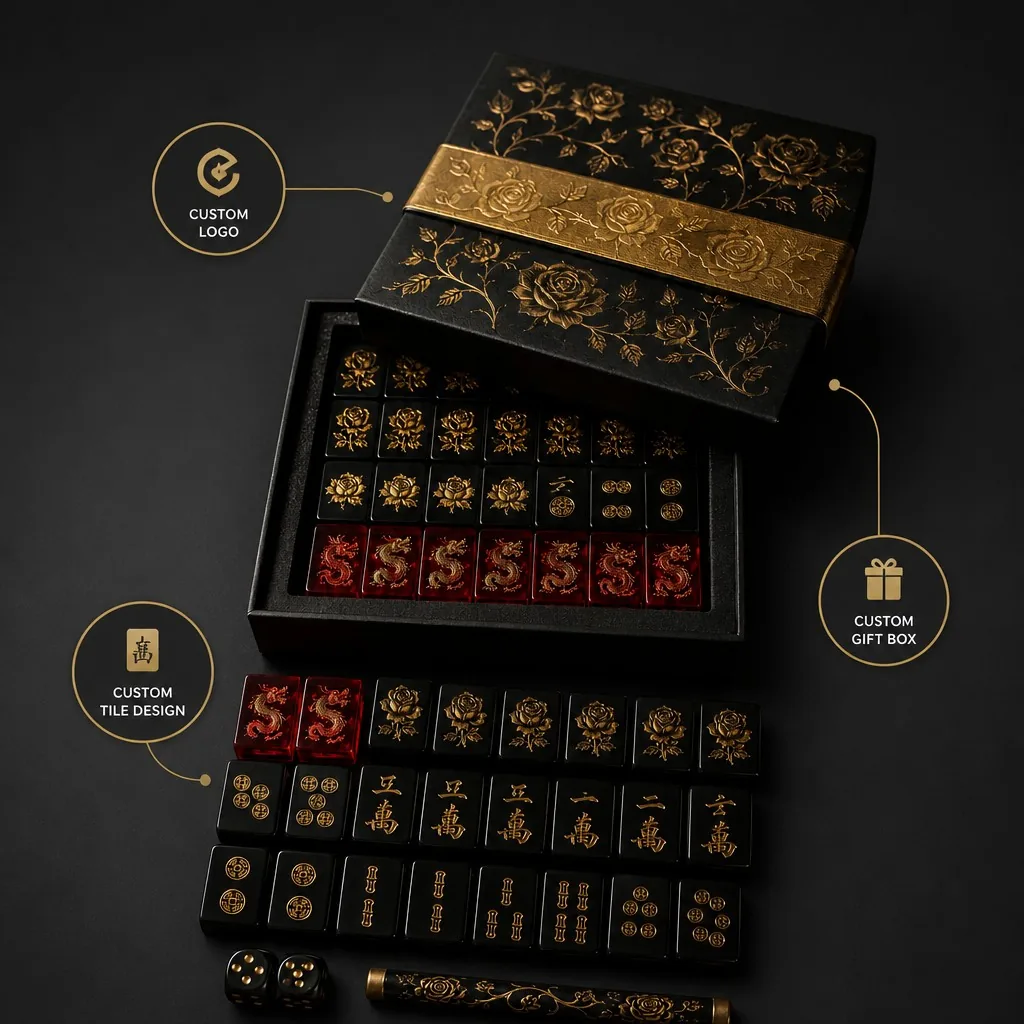
Customization is where the brief usually drifts. A logo on the box lid is a print file and a colour target. A custom tile design is new engraving artwork, a new depth trial and a new fill test, and it is priced per tile face rather than per set. A custom box is a new die line. Ask for those three as three separate lines on the quotation, or the first sample will arrive with the box done and the tiles unchanged.
Where this set is the wrong product
It is a gift box, not a display case. There is no window, no dust seal and no UV block, so a set left out between games will collect dust in the engraved roses within a month, and the dust will be visible because the grooves are gold. A buyer who wants the set on show should be pointed at a case, not at this box.
Black plus engraving is also high maintenance. A venue that wipes the tiles with a general-purpose cleaner will dull the fill and haze the body, and the damage shows first on the tiles that get handled most, which are the ones nearest the wall. The care note has to name a microfibre cloth and a mild soap and water, and it has to say what not to use.
Two neighbours in the same category solve different problems. If the brief needs light, the light-up mahjong gift set puts a lit case around the game. If the brief needs a printed story on the box, the ukiyo-e acrylic mahjong set wraps a Great Wave across a four-drawer box. This one is the quiet version: no light, no print on the tile, one engraved motif and a gold band.
What to send for a quoted sample
- Tile count and tile format for the destination market, in writing
- Whether the body should be gloss or semi-matte, and where the set will be used
- Engraving artwork as vector, plus confirmation that the rose is your own or licensed
- Fill preference: paint, foil or frost, with the light the set will be seen in
- Box wrap artwork, logo placement, and whether the band carries the pattern or sits plain
- Quantity, destination port and shipping month, since the wrap and the packing are quoted together
Send the brief through the project enquiry form. The acrylic mahjong collection and the acrylic gifts collection cover the rest of the range.